Rembrandt van Rijn: Luminous Shadows & Theatrical Focus
Discover Rembrandt's master principles of dramatic illumination, focal hierarchy, lost edges, and dominant shadow masses.
Light as a Compositional Tool
Most beginning artists try to illuminate everything on the canvas equally—giving every face, cloth fold, hand, and background detail identical sharpness and brightness. The result is visual chaos where nothing stands out because everything is shouting for attention.
Rembrandt took the opposite approach:
Light is not passive exposure; it is a theatrical spotlight directing the viewer's gaze exactly where the emotional story happens.
Darkness suppresses secondary information, eliminating visual clutter so the primary subject can command the space.
The viewer does not need equal visual information everywhere. Surrendering large areas to quiet values creates breath and gravity.
“Think of the 70% shadow idea as a practical studio exercise: allow roughly two-thirds of your composition to live in quieter, darker, or less assertive values, then reserve your strongest lights for the places you most want the viewer to notice.”
This is a flexible studio tool for establishing tonal dominance, not a rigid mathematical formula.
Study the Master: Four Paintings, Four Lessons
To truly understand Rembrandt's handling of light, shadow, and theatrical focus, study high-resolution authentic reproductions from the world's leading museum collections. For each painting, follow the Look First, Read Second observation exercise.
1. The Night Watch (1642) — Rijksmuseum, Amsterdam
- Where does your eye go first? Notice the bright yellow lieutenant and the captain's illuminated face and gesture.
- Where does your eye travel next? Spot the glowing young girl emerging like an apparition in the golden half-light behind them.
- Which areas are allowed to remain completely dark? Look at the vast upper archway and the shadowy figures deep in the background.
- How does the captain's outstretched hand cast a shadow? Notice how the shadow falls directly onto the lieutenant's golden coat, creating palpable physical depth.
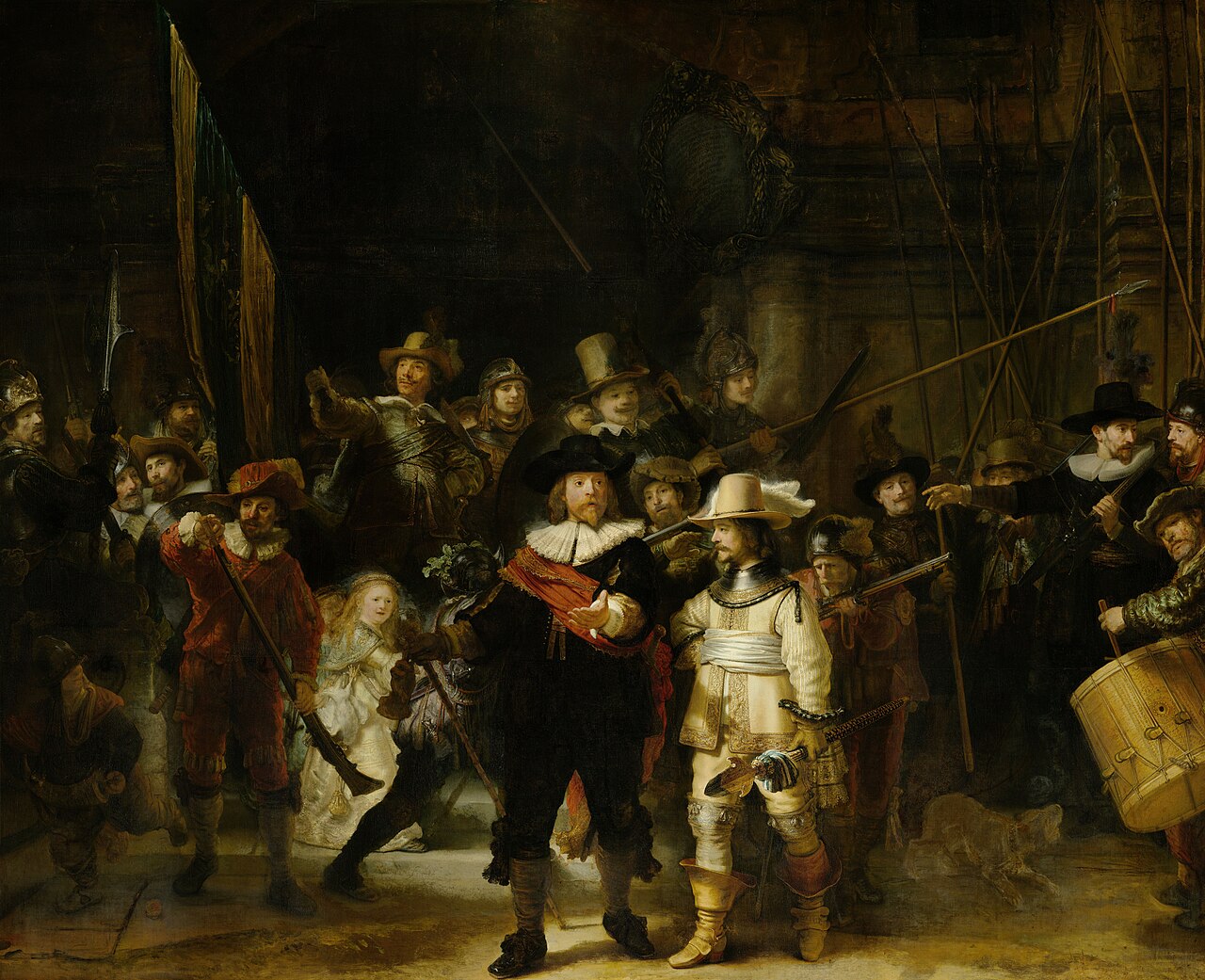
Oil on canvas, 379.5 × 453.5 cm • Rijksmuseum, Amsterdam (SK-C-5)
What Rembrandt Teaches Us in The Night Watch:
In traditional 17th-century Dutch civic guard portraits, every member paid an equal fee and expected an equally lit, stiff headshot. Rembrandt rejected this flat democracy. He staged an energetic theatrical event:
- Selective Illumination: Rather than lighting all 34 figures equally, he cast roughly 75% of the canvas in mysterious, warm umber gloom.
- Movement Through Light: The brilliant yellow jacket of Lieutenant Willem van Ruytenburch and the luminous dress of the young girl act as optical lanterns pulling us into the scene.
- Focal Weight: Because the surroundings are so deep and quiet, small illuminated details—like the glint of steel on a pike or the lace on a collar—carry enormous visual power.
2. Belshazzar's Feast (c. 1636–1638) — The National Gallery, London
- Where is the absolute brightest point of light? Find the divine glowing Hebrew letters appearing magically on the dark wall.
- Where is the second brightest area? Look at King Belshazzar's face, his eyes wide in terror, and the dazzling gold brocade of his cloak.
- How does light guide the narrative? Follow the diagonal ray from the supernatural writing to the king's head, down his outstretched arm, to the overturned wine goblet.
- What is hidden in the dark? Notice how the banquet guests and background architecture are submerged in shadowy obscurity.
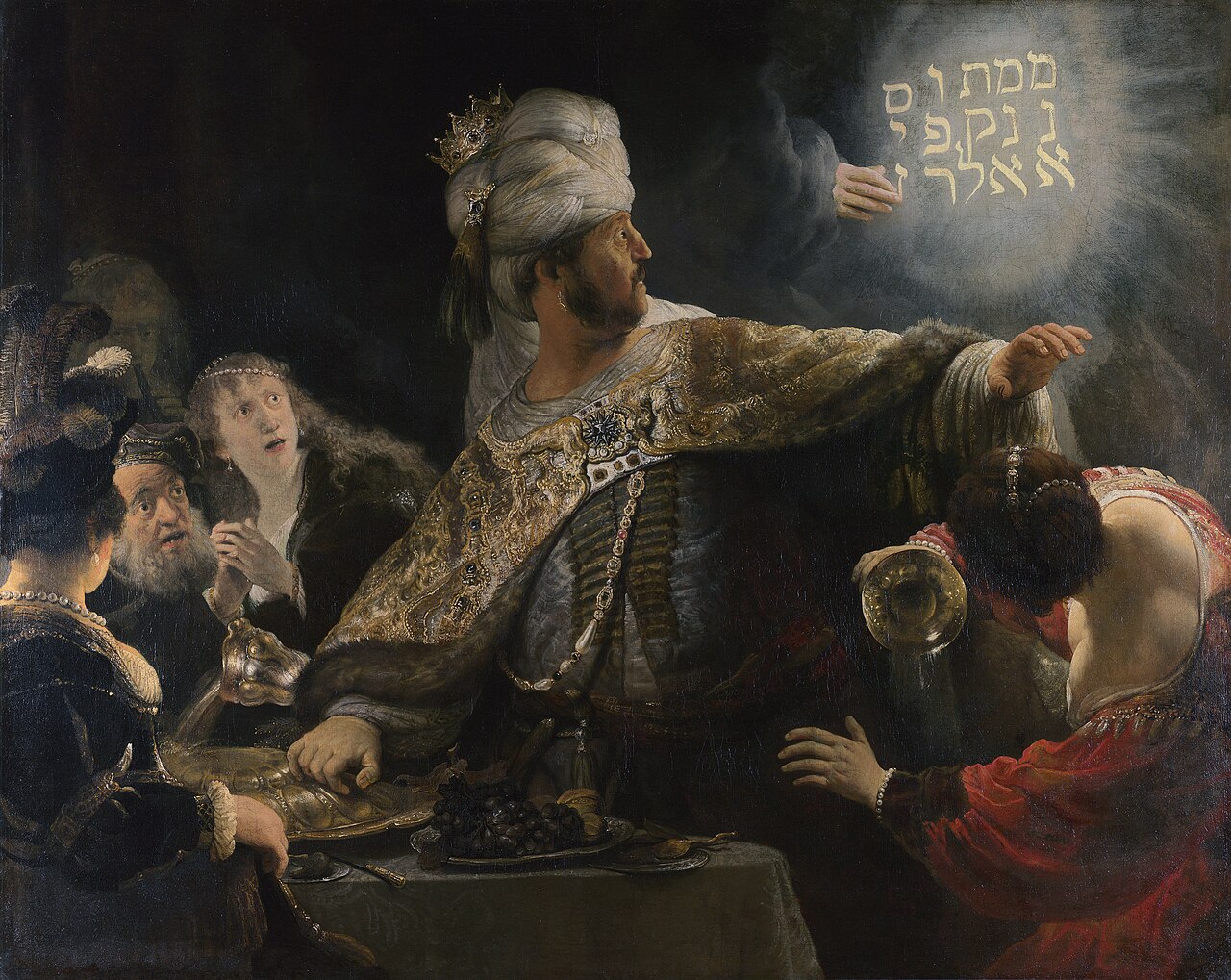
Oil on canvas, 167.6 × 209.2 cm • The National Gallery, London (NG6350)
What Rembrandt Teaches Us in Belshazzar's Feast:
- Light as Narrative Catalyst: The light does not come from a natural lamp or candle; it emanates directly from the miraculous writing on the wall.
- Theatrical Staging & Suppression: By plunging the banquet room into deep, velvety umbers and near-black tones, Rembrandt strips away every distraction. You cannot look anywhere except the terror of the king.
- Contrast as Emotion: The extreme contrast between the luminous writing and the dark surrounding air mirrors the shock and psychological dread of the biblical narrative.
3. Self-Portrait at the Age of 63 (1669) — The National Gallery, London
- Where is the detail concentrated? Look closely at the forehead, nose, and the tired, perceptive eyes.
- Where do edges disappear completely? Look at the artist's beret and shoulders—where do they merge into the dark background?
- How are the clasped hands painted? Notice how the hands are rendered with loose, soft, almost indistinct strokes compared to the face.
- What is in the background? Absolutely nothing—just pure, resonant, warm atmosphere.
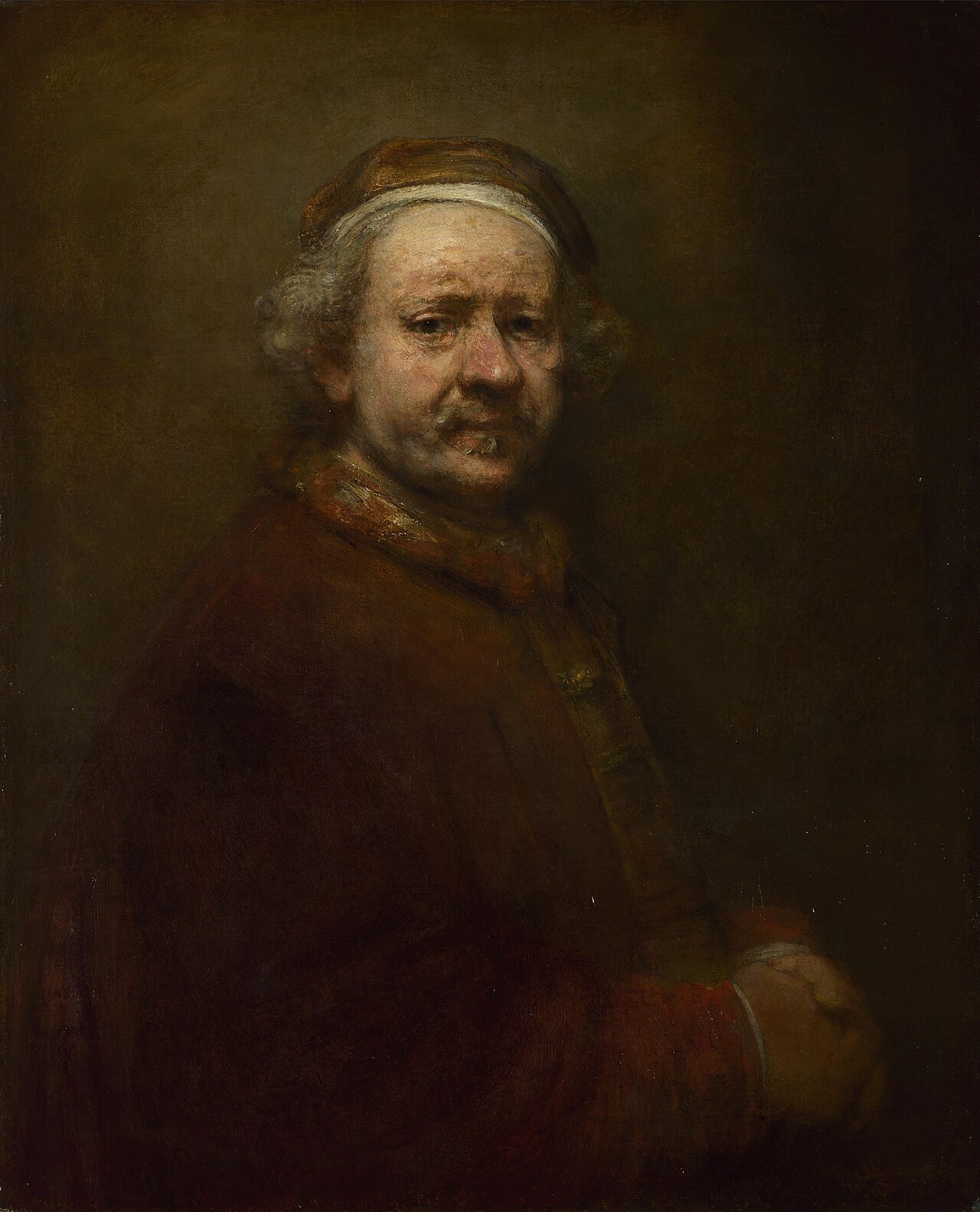
Oil on canvas, 86 × 70.5 cm • The National Gallery, London (NG221)
What Rembrandt Teaches Us in Late Self-Portraits:
- Lost Edges: Rembrandt understood that crisp outlines flatten form. In the shadows, the boundary between his dark red coat and the dark background is completely lost.
- Selective Detail: Painted in the final year of his life, this portrait proves that not every square inch of a canvas needs equal finish. He built thick, sculpted paint (impasto) only on the lighted planes of the face, leaving the rest soft and quiet.
- Psychological Intimacy: By eliminating all background objects, he brings the viewer into direct, unmediated contact with the human soul.
4. The Jewish Bride / Isaac and Rebecca (c. 1665–1669) — Rijksmuseum, Amsterdam
- What is the emotional focal point? Look at the man's tender hand resting gently on the woman's breast, and her fingers lightly touching his.
- How does color reinforce the light? Notice the glowing, sculpted gold impasto on the man's sleeve and the warm, luminous vermilion-crimson of her gown.
- Where does the light fade? Notice how the couple emerges softly from a completely subdued, dusky architectural setting.
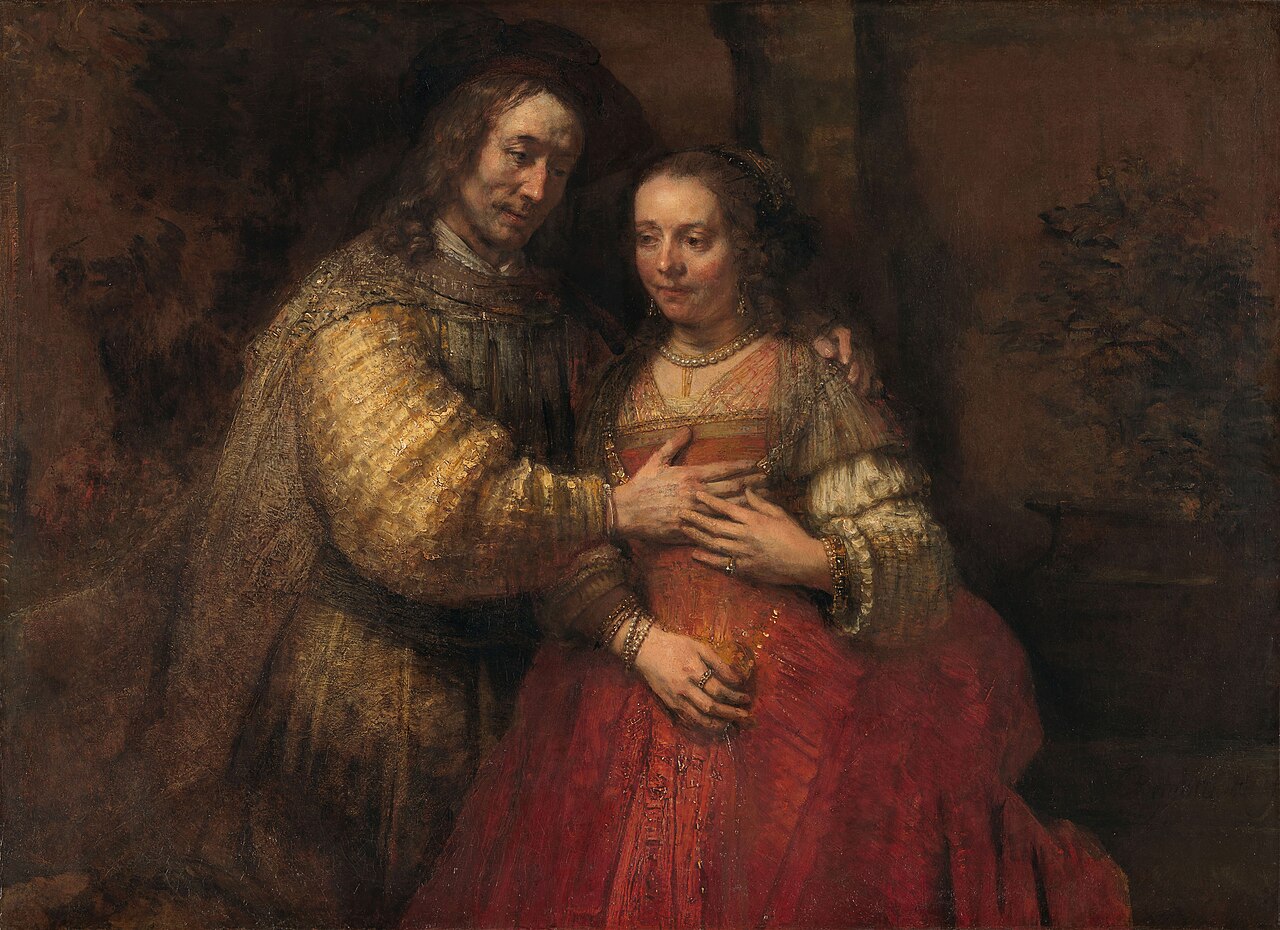
Oil on canvas, 121.5 × 166.5 cm • Rijksmuseum, Amsterdam (SK-C-216)
What Rembrandt Teaches Us in The Jewish Bride:
- Intimate Illumination: Here, chiaroscuro is not used for shock or violence, but to create profound tenderness and sacred privacy.
- Tactile Impasto: Vincent van Gogh famously remarked that he would gladly give up ten years of his life just to sit before this painting for two weeks with a crust of bread. The rich, troweled impasto on the sleeve catches actual ambient light.
- Light Centered on Gesture: The highest value contrast and warmest saturated chroma are reserved exactly where their hands meet.
Rembrandt's 4-Tier Focal Hierarchy
When planning a master painting, Rembrandt organized every element into four clear hierarchical tiers:
The Star of the Scene
Where maximum value contrast, warmest color chroma, sharpest edges, and thickest paint impasto are concentrated (e.g. Belshazzar's face, the illuminated girl in The Night Watch).
Supporting Characters
Transitional elements that receive light but with softer edges, slightly muted values, or simpler strokes (e.g. the lieutenant's coat, the clasped hands, secondary banquet guests).
Atmospheric Context
Background architecture, drapery folds, or props that establish setting without competing for the viewer's attention.
The Quiet Envelope
Deep, warm, transparent shadows and lost edges where forms dissolve. This large mass provides the dark foundation that makes the light sing.
Try the Rembrandt Principle: Unequal Visual Weight
Before you begin painting, divide your canvas mentally into unequal value zones:
Quiet, darker, or less assertive values that provide depth, atmosphere, and mystery.
Transitional planes that model three-dimensional volume and connect light to shadow.
The crisp, luminous highlights and saturated accents reserved exclusively for your primary focus.
Hands-On Studio Exercise: Paint with Theatrical Focus
Set up a simple subject in your studio: a single fruit, a flower, a ceramic cup, a small sculpture, a friend's portrait, or a pet. Follow Rembrandt's 7-step studio process:
Tone Your Canvas Dark & Warm
Never start on a blinding white canvas. Stain your surface with a warm transparent wash of raw umber, burnt sienna, or yellow ochre mixed with turpentine/mineral spirits. Let this under-tone establish a harmonious shadow mass.
Position a Single Directional Light Source
Use a single lamp, candle, or high side-window (raking light at roughly 45 degrees). Avoid multi-source lighting, which flattens form and scatters confusion.
Surrender 70% of the Canvas to Quiet Values
Block in the big shadow shapes boldly. Resist the temptation to paint detail in the shadows. Keep the darks thin, transparent, and quietly unified.
Choose ONE Primary Focal Area
Select the exact spot where the story lives (e.g. the rim of the cup where light strikes, the apple's highlight, or the eye socket and cheekbone of a portrait).
Reserve Your Strongest Contrast & Impasto
Mix your purest light tone (lead/titanium white with a touch of warm yellow/ochre) with thicker, opaque paint. Apply it decisively onto the primary focal plane.
Allow Secondary Edges to Dissolve
Use a soft dry brush or your finger to soften edges on the shadow side. Let the shadow edge of the object blend directly into the background without an outline.
Step Back 6 Feet & Test Your Hierarchy
Step back across the room and squint. Ask: “Where does my eye go first?” If your eye gets pulled toward a distracting corner or secondary object, glaze that area down with transparent dark paint immediately!
Masterwork Analyzer: Deconstruct Rembrandt's Light
Explore how Rembrandt constructed focal hierarchy, value masses, and lost edges across the actual museum masterpieces. Select an artwork and toggle the analytical study layers below:
Observe the authentic painting: Rembrandt plunged roughly 75% of the composition into deep, resonant shadow, allowing Captain Banninck Cocq and Lieutenant Willem van Ruytenburch to step forward with magnetic dramatic weight.
Rembrandt's Question for Your Easel
Every time you stand before your canvas, Rembrandt's master principle provides an unmistakable guide:
Where you allow darkness to remain tells the viewer what does NOT need to compete.”
When you embrace shadow not as an absence, but as a deliberate, protective envelope for your light, your paintings gain timeless weight, drama, and atmosphere.
Authoritative Museum References
All reproductions in this guide are authentic historical masterpieces preserved in world museum collections and presented for open-access art education:
| Artwork | Date & Medium | Museum & Inventory | Official Collection Link |
|---|---|---|---|
| The Night Watch Militia Company of District II... |
1642 Oil on canvas, 379.5 × 453.5 cm |
Rijksmuseum, Amsterdam Object: SK-C-5 |
Rijksmuseum Object Page → |
| Belshazzar's Feast | about 1636–8 (c. 1636–1638) Oil on canvas, 167.6 × 209.2 cm |
The National Gallery, London Inventory: NG6350 |
National Gallery NG6350 → |
| Self-Portrait at the Age of 63 | 1669 Oil on canvas, 86 × 70.5 cm |
The National Gallery, London Inventory: NG221 |
National Gallery NG221 → |
| The Jewish Bride Portrait of a Pair as Isaac and Rebecca |
c. 1665–1669 Oil on canvas, 121.5 × 166.5 cm |
Rijksmuseum, Amsterdam Object: SK-C-216 |
Rijksmuseum Object Page → |