Pablo Picasso: Break the Rules of Perspective
Most of us learn to draw by choosing one viewpoint and trying to make everything look the way it appears from that position. Picasso asked a different question: What if one viewpoint isn't enough?
The Big Idea: Breaking the Illusion of the Fixed Viewpoint
For five centuries after the Renaissance, European artists treated the canvas as a transparent window into a believable three-dimensional space governed by linear perspective. In early 20th-century Paris, Pablo Picasso dismantled this assumption. He recognized that human experience of an object is never static: we walk around it, remember its profile while looking at its front, and understand its physical volume from multiple vantage points simultaneously.
Simultaneous Viewpoints
Showing the profile and frontal view of a face at the same time, or the top opening of a glass alongside its side silhouette, embedding time and movement into a single canvas.
Planar Faceting
Breaking continuous organic forms into crystalline, geometric planes that tilt, reflect, and catch light like the facets of a cut gemstone.
Rearranged Picture Planes
Shuffling the foreground, subject, and background so they sit on the same physical plane, eliminating the illusion of deep receding space.
Interlocking Graphic Shapes
Constructing figures out of flat, bold color shapes and rhythmic patterns that lock together like a visual puzzle across the surface.
Look Closely: Four Authentic Picasso Masterwork Studies
Before reading the technical analysis, spend 20 seconds observing each authentic masterwork. Train your eyes to identify what you see, what Picasso did, why it works, and what you can try in your own sketchbook.
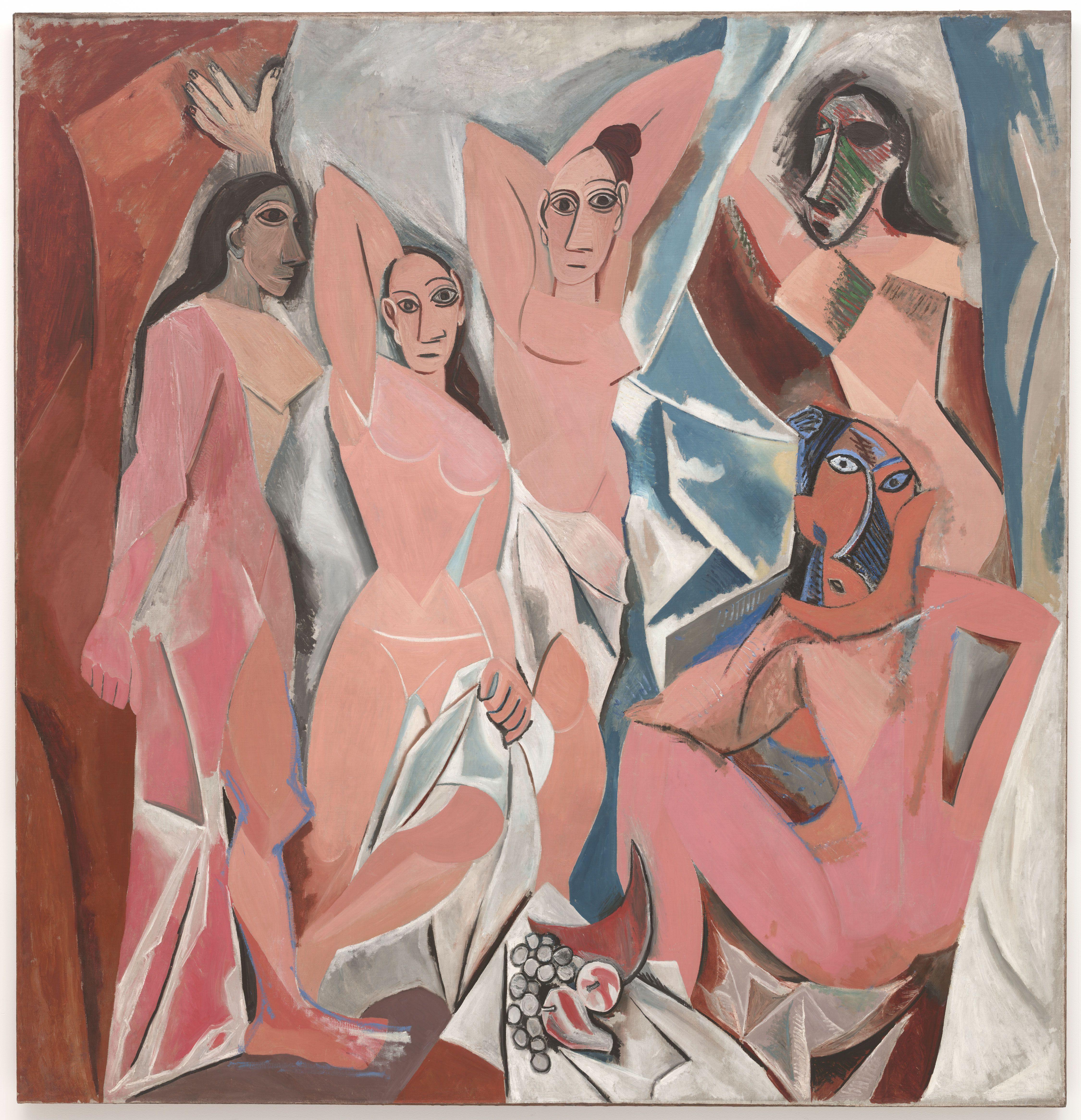
Five monumental figures confronting the viewer with angular, fractured anatomy, sharp geometric planes, and competing spatial vantage points.
He disrupted conventional spatial perspective and made the flat picture surface itself an active battleground of competing viewpoints.
The viewer is no longer looking through a passive window into a room; the eye must actively reconcile fractured angles and planes across the canvas.
Allow an object or figure to present more than one visual angle within the same unified composition.
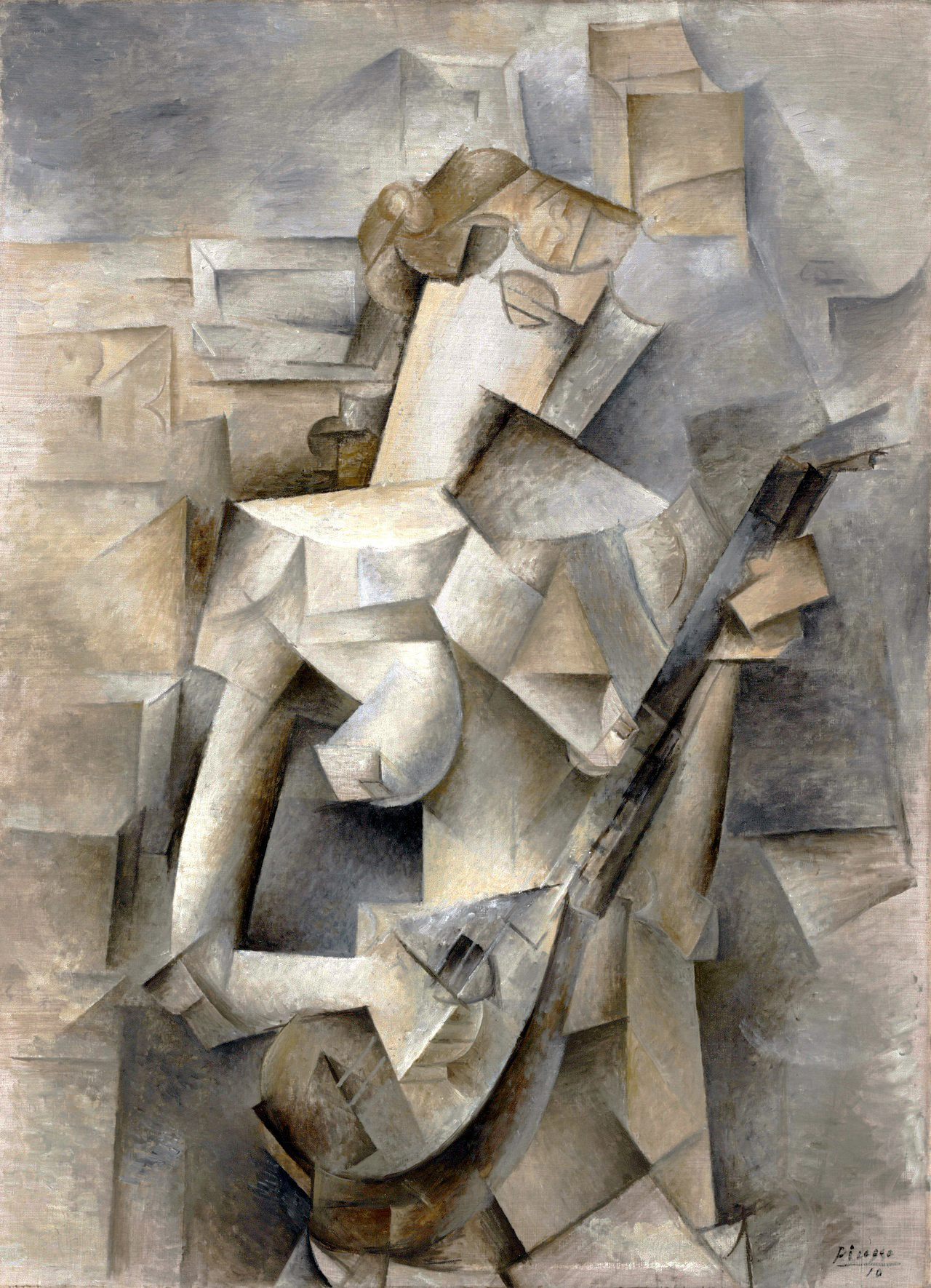
A seated woman holding a mandolin, broken down into overlapping ochre, taupe, and bronze geometric facets where the instrument and figure merge with the background.
He deconstructed recognizable human anatomy into interconnected geometric planes, subverting traditional chiaroscuro modeling.
The viewer mentally reconstructs the figure from structural fragments, turning observation into an active act of visual deciphering.
Take a recognizable subject and reduce its complex curves into a small set of interlocking flat planes.
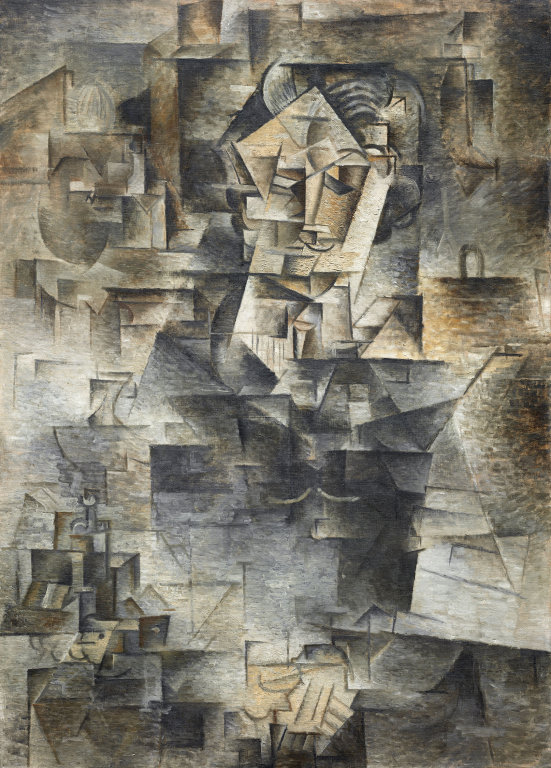
A shimmering lattice of vertical, horizontal, and diagonal planes in subtle greys and ochres, punctuated by small recognizable anchors: clasped hands, a watch chain, and hair waves.
He presents the art dealer through overlapping and shifting planes seen from multiple angles, completely dissolving the boundary between sitter and ambient space.
The viewer gradually reconstructs the subject over time, experiencing multiple temporal and physical vantage points simultaneously.
Draw an object from three distinct positions, then merge the most compelling fragments into one cohesive analytical study.
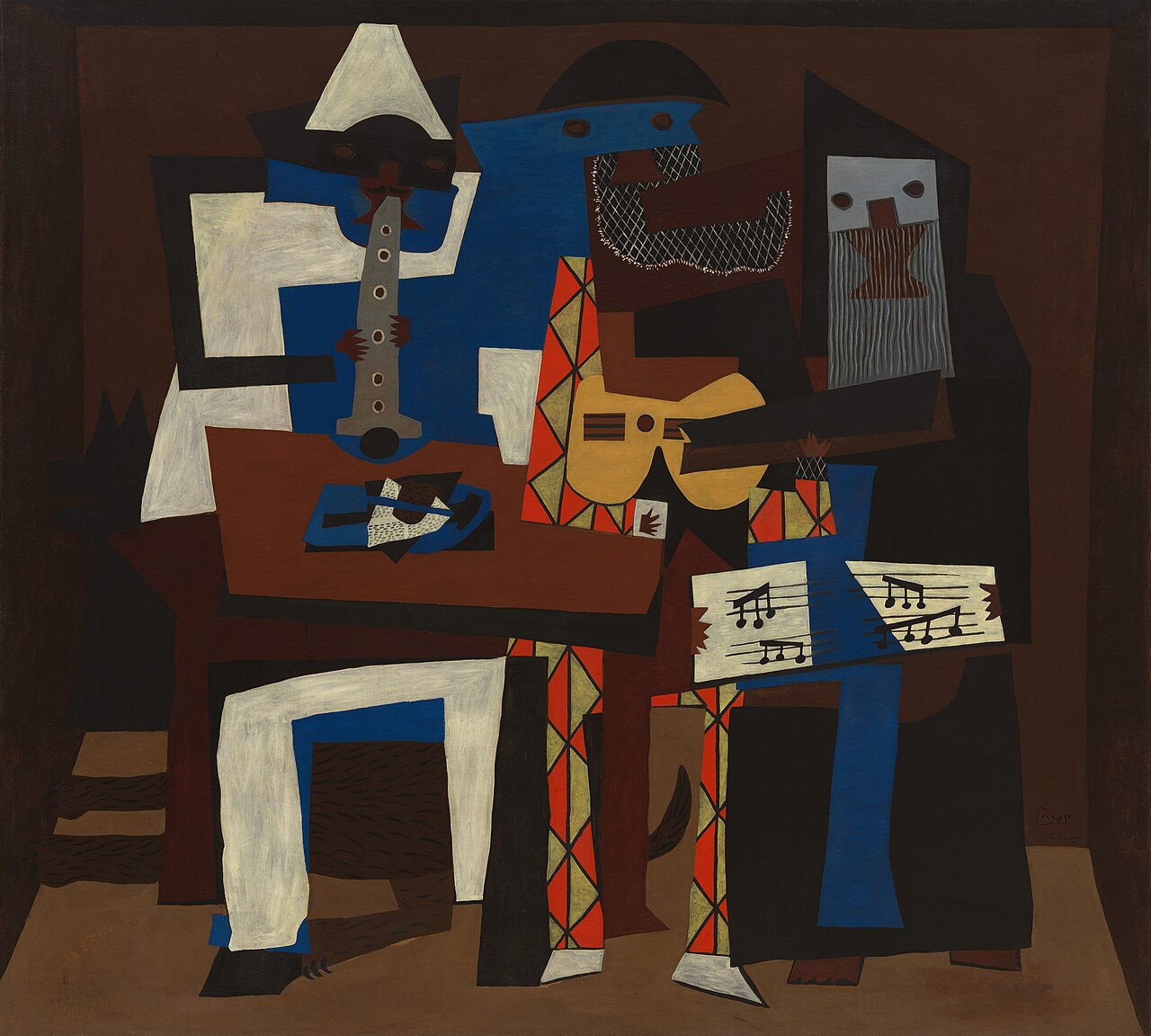
Three costumed figures (Harlequin, Pierrot, and a monk) seated at a table with sheet music and a clarinet, built from bold, flat, interlocking colored shapes.
He synthesized multiple viewpoints into crisp, graphic silhouette cutouts and bold color blocks, functioning like an architectural collage.
The composition operates as a masterfully balanced visual puzzle where rhythmic patterns and solid color shapes hold complex spatial layers together.
Build a complete composition out of large, interlocking colored shapes before adding any small descriptive details.
What Picasso Changed: A New Visual Language
A photograph records one single viewpoint at one fraction of a second. But a painting does not have to behave like a camera. By freeing the artist from the tyranny of the fixed vantage point, Picasso expanded what painting can communicate:
Show Multiple Viewpoints
Combine what you see from the front, profile, above, and inside into one continuous composition.
Flatten & Compress Space
Push deep backgrounds forward onto the same surface plane as the primary subject.
Fragment & Rearrange Planes
Disassemble anatomy or objects into distinct geometric tiles, shifting them to create unexpected visual rhythm.
Active Deciphering
Leave selective clues (a keyline, button, eye, or string) so the viewer actively participates in reconstructing the subject.
"You don't have to abandon reality to transform it. You can begin by looking at it from more than one point of view."
The Multiple-Viewpoint Challenge
Now it's your turn. Choose one ordinary object and stop trying to draw it from only one position. We study the artist's decisions, not to reproduce the artist's paintings, but to discover what those decisions make possible in our own work.
Draw It Once (Standard Viewpoint)
Choose an ordinary object you can observe in person: a coffee mug, vase, shoe, chair, piece of fruit, glass bottle, scissors, flower, or your own hand. Draw it honestly from your normal seated position. Do not stylize or distort it yet.
Move & Draw Again (Second Viewpoint)
Stand up or walk to the side. Look at the exact same object from a 90-degree profile or 45-degree angle. Draw what is visible now that was hidden in your first drawing.
Move Again (Extreme Birds-Eye or Low Angle)
Look directly down into the opening of the object from above, or get below eye level and look up at its base. Create a quick third contour drawing capturing this distinct vantage point.
Take It Apart (Identify Key Fragments)
Review your three studies. Use a pencil to circle the most expressive shapes and contours: the circular rim from above, the handle silhouette from the side, the shadow plane from the front.
Put It Back Together (Synthesize into One)
Start a new drawing. Combine fragments from your different viewpoints into a single unified composition. For example: show the circular opening from directly above, attached to a profile handle and a faceted front body. The final object does not need to be physically possible.
Make It Yours (Tone, Shape & Structure)
Reinforce key dividing lines, fill selected planes with contrasting values or flat color blocks, and treat background shapes as deliberate interlocking pieces. Step back and evaluate the dynamic rhythm of your original creation.
Interactive Masterwork Analyzer
Explore four authentic Picasso masterworks and toggle three analytical inspection layers to see simultaneous viewpoints, faceted planar fractures, and interlocking geometric shape architectures mapped directly onto the paintings.
Authentic high-resolution scan of Pablo Picasso's Les Demoiselles d'Avignon (1907) from The Museum of Modern Art (MoMA) collection (Object No. 333.1939).
Atelier Reflection & Creative Philosophy
"I paint objects as I think them, not as I see them." — Pablo Picasso
Reflection Questions for Your Sketchbook:
1. "What became possible when you stopped asking, 'How does this object really look?' and started asking, 'How many ways can I see it?'"
2. "Which viewpoint became the most interesting or surprising when you combined it with other angles?"
"Sometimes breaking a rule is not about rejecting the rule. It's about discovering what becomes possible when you stop being limited by it."
Academic Sources & Museum Credits
All artworks presented in this masterclass are authenticated historical masterworks by Pablo Picasso from The Museum of Modern Art (MoMA), New York, and the Art Institute of Chicago.
| Artwork Title | Date & Medium | Dimensions | Collection / Accession | Official Museum Source |
|---|---|---|---|---|
| Les Demoiselles d'Avignon | 1907, Oil on canvas | 8 ft. × 7 ft. 8 in. (243.9 × 233.7 cm) | The Museum of Modern Art • 333.1939 | MoMA Object 79766 → |
| Girl with a Mandolin (Fanny Tellier) | 1910, Oil on canvas | 39 1/2 × 29 in. (100.3 × 73.6 cm) | The Museum of Modern Art • 966.1979 | MoMA Object 80430 → |
| Daniel-Henry Kahnweiler | 1910, Oil on canvas | 39 9/16 × 28 9/16 in. (100.4 × 72.4 cm) | Art Institute of Chicago • 1948.561 | AIC Artwork 111060 → |
| Three Musicians | 1921, Oil on canvas | 6 ft. 7 in. × 7 ft. 3 3/4 in. (200.7 × 222.9 cm) | The Museum of Modern Art • 55.1949 | MoMA Object 78630 → |