Georgia O'Keeffe: Monumental Organic Silhouette
Learn American Modernist techniques of bold close-up cropping, pristine gradient blending, and magnifying nature into expressive abstract forms.
The Big Idea: Monumental Scale & Pure Form
In the 1920s, American art was caught between European academic realism and rapid industrial urbanization. Georgia O'Keeffe forged a radically new visual language: she isolated organic botanical subjects and magnified them to enormous proportions. By eliminating stems, soil, and garden context, she compelled busy city viewers to slow down and experience the pure sculptural geometry of living forms.
Radical Macro Cropping
O'Keeffe pushes the camera-like viewfinder directly into the center of the blossom. Petals surge past all four canvas borders, converting a delicate miniature bloom into an immense landscape.
Pristine Gradient Blending
Unlike the broken, textured brushmarks of Monet or Van Gogh, O'Keeffe blends oil paint with porcelain-smooth transitions. Seamless gradations describe light and form without distracting surface clutter.
Disciplined Edge Control
Silhouettes alternate between razor-sharp graphic boundaries and velvety, out-of-focus interior folds, directing the viewer's eye through a rhythmic spatial journey.
Active Negative Space
The background is not passive filler. Compressed negative space pockets act as sculptural counterweights that intensify the energy of the positive organic mass.
Look Before You Read: Four Authentic Masterwork Studies
Before reading technical analysis, spend 20 seconds observing each authentic masterwork. Train your eyes to identify what you see, what O'Keeffe did, why it works, and what you can try.
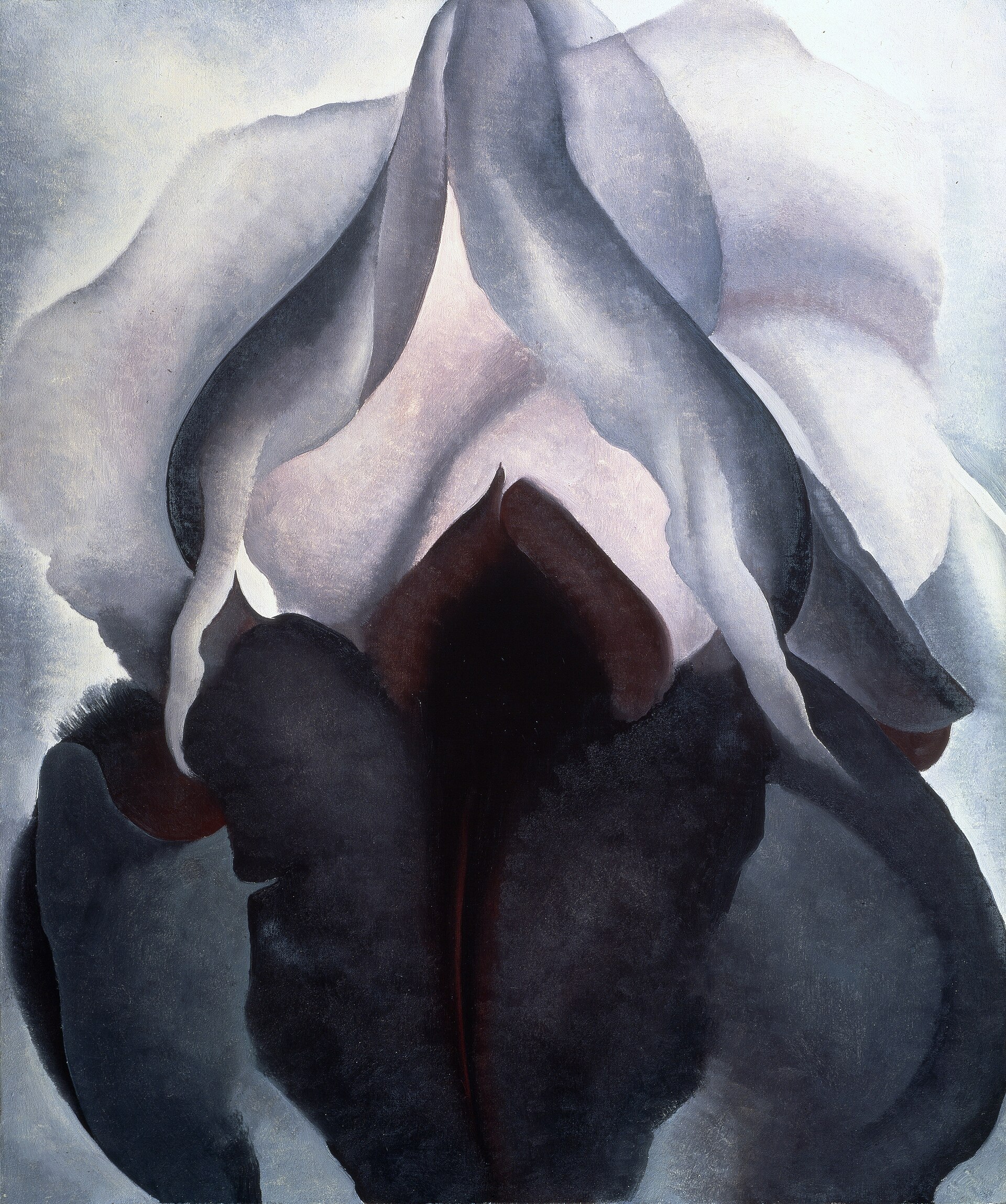
A towering, shadowy iris petal structure that expands outward to touch almost every edge of the frame, rising from deep plum into translucent pinkish-gray.
She placed the darkest, most cavernous shadow mass directly at the center and surrounded it with delicate, paper-thin billowing petals that fade into airy highlights.
The extreme value contrast (deepest charcoal/black against luminous pearl gray) gives the delicate flower the dramatic physical presence of a mountain canyon.
Place your darkest value anchor right in the core of an organic form and let outer shapes dissolve into soft, glowing tones.
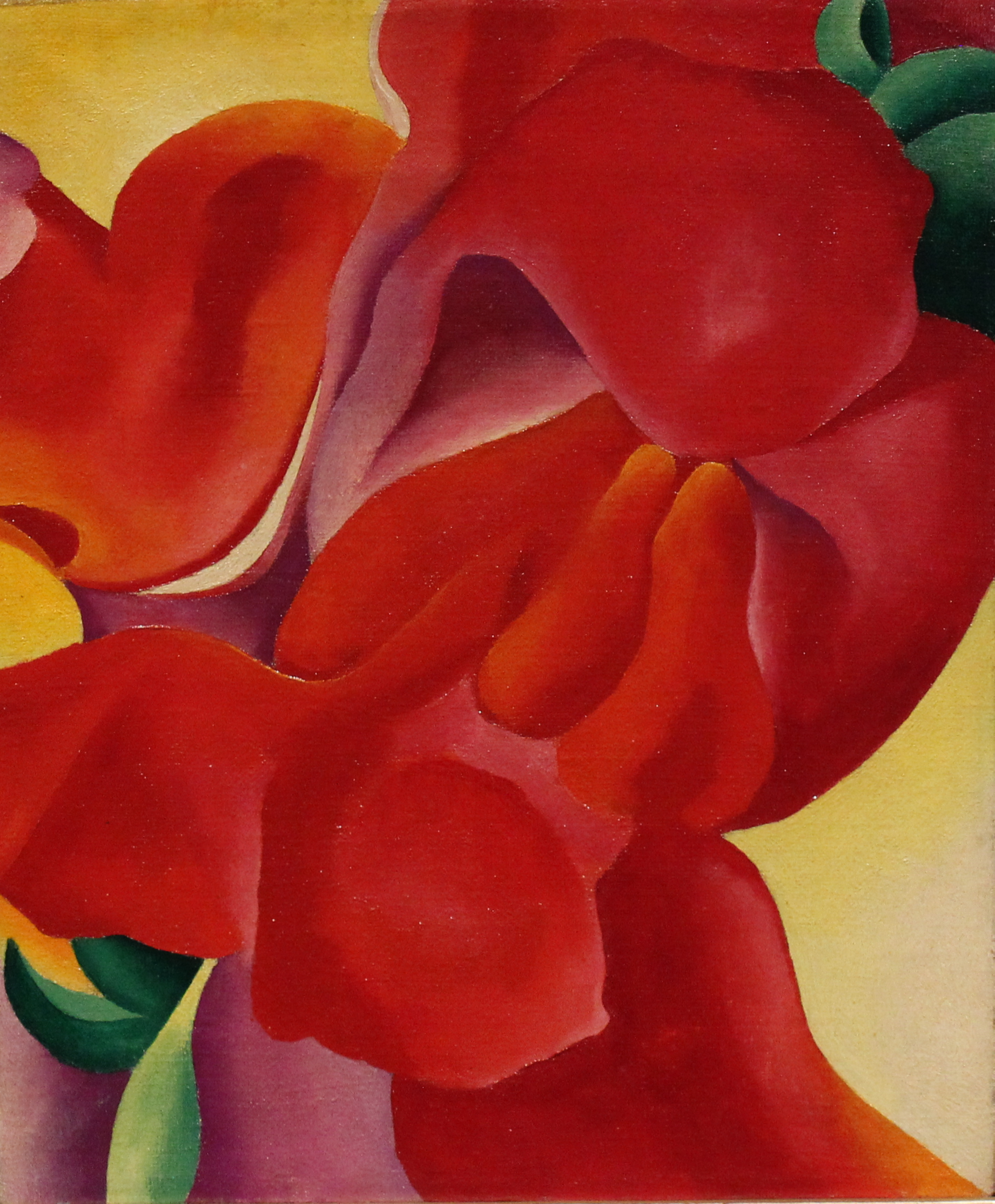
A flame-like eruption of diagonal curving petals surging from bottom-left to top-right in blazing crimson, cadmium red, and warm yellow.
She cropped so tightly that background space is 100% eliminated. The flower itself becomes the entire universe of the canvas.
The continuous diagonal C-curves and warm chromatic transitions create kinetic visual energy, making the botanical subject feel alive with thermal heat.
Eliminate the background entirely. Force the organic subject to touch or burst through all four sides of your canvas.
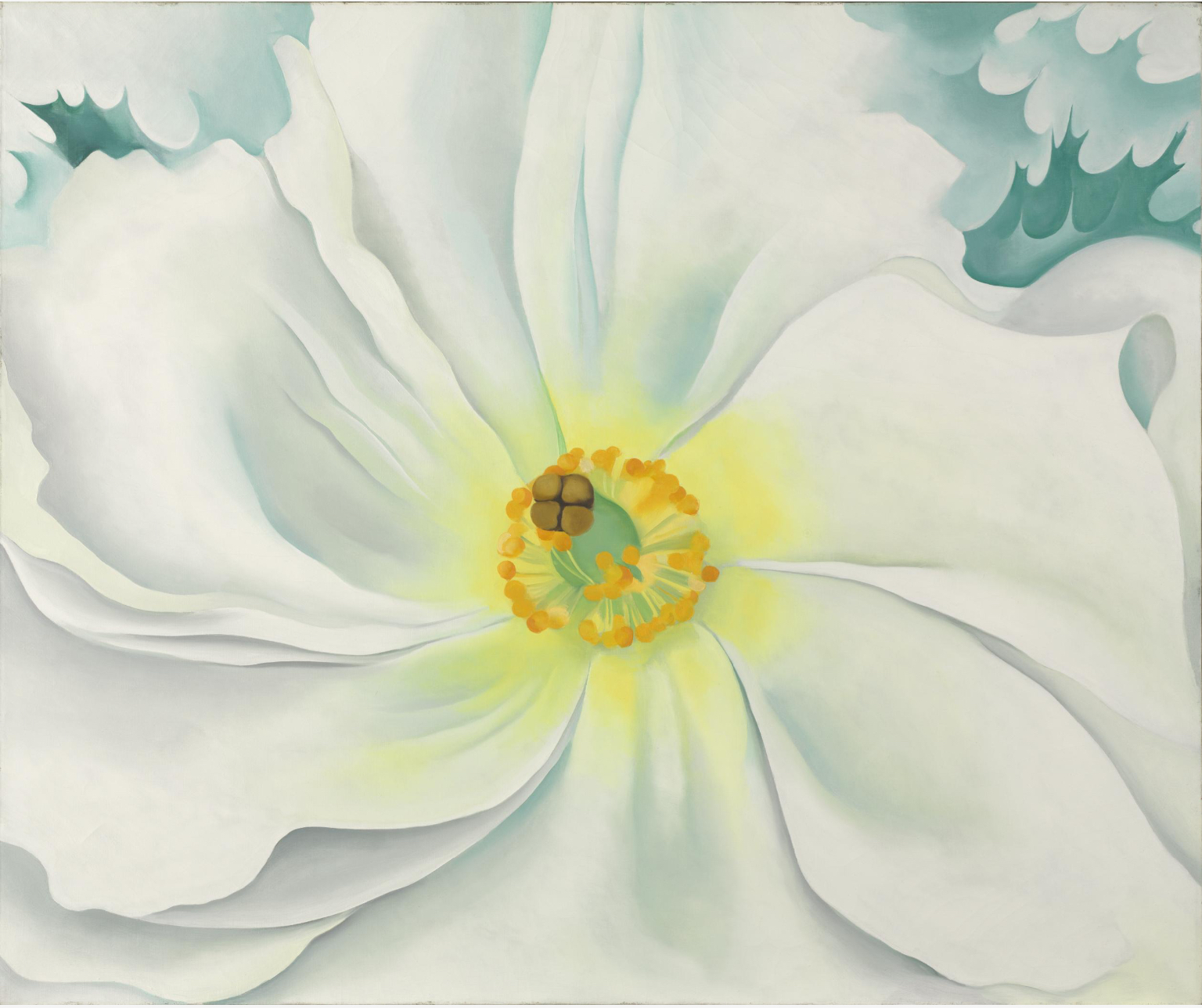
A luminous, pristine white blossom with five pinwheel points opening toward the viewer, set against deep green rhythmic leaves.
She utilized subtle, porcelain-smooth white-to-green gradient shading within the petal folds to carve delicate three-dimensional volume without harsh black shadow.
The crisp, pinwheel-like star silhouette contrasts against dark surrounding foliage, giving the humble New Mexico wildflower architectural nobility.
Model a light-toned subject using tints of neighboring environmental colors (pale sage, cream, sky blue) rather than grey or black.
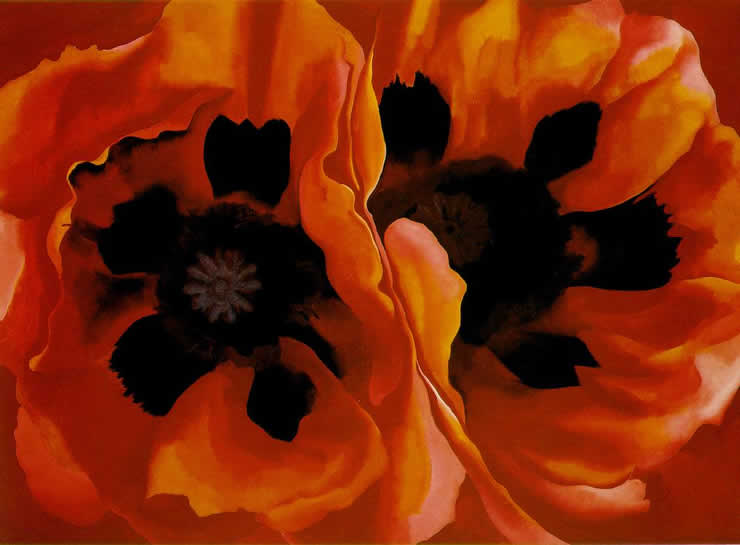
Two colossal red-orange poppy blossoms interlocking across a wide landscape format, dominated by cavernous, velvety dark purple/black centers.
She created a powerful dual-focal balance where the warm outer petals vibrate against the cool, dark stamen cavities.
The saturated complementary contrast between blazing orange-red and inky charcoal plum generates intense optical vibration across the surface.
Pair two interlocking organic masses to create a dynamic rhythm across a wide canvas rather than centering a single subject.
The Four Modernist Visual Pillars
To incorporate O'Keeffe's monumental vision into your own work, master these four core studio pillars.
1. Extreme Close-Up Cropping
Move past the conventional perspective of viewing an object from a distance. Cut off outer edges, push the focal heart forward, and let the anatomy of the subject dictate the canvas frame.
2. Pristine Gradient Blending
Master the art of seamless value shifts. Transition from highlight to deep core shadow with gradual, untextured gradation to give organic surfaces a sculpted, luminous glow.
3. Dynamic Edge Control
Keep leading outer silhouettes crisp and decisive, while allowing interior folds and receding planes to melt into soft, atmospheric transitions.
4. Active Negative Space
Treat background shapes as deliberate sculptural cutouts. Every sliver of background should have an interesting, intentional silhouette that supports the primary subject.
Hands-On Studio Exercise: "Monumental Nature"
Do not copy Georgia O'Keeffe's paintings. Take her visual principles of close-up magnification and build your own original monumental interpretation of nature.
Select an Intimate Natural Subject
Find a single organic subject that you can observe closely: a flower, leaf, sea shell, feather, seed pod, polished stone, or piece of weathered driftwood.
Crop In Radically with a Viewfinder
Frame the subject so tightly that it bursts past at least three or all four edges of your canvas. Eliminate the stem, table, or background clutter completely.
Map the Dominant Organic Curves
Lightly sketch 3–4 primary sweeping C-curves and S-curves. Look for the largest and most sculptural contours rather than trying to draw every tiny vein or wrinkle.
Establish Deep Value Anchors
Identify where the deepest shadow mass sits (e.g. inside a petal funnel or shell cavity). Block in this deep tone to create a spatial anchor for your entire composition.
Blend Pristine Chromatic Gradients
Apply smooth, untextured color transitions across each plane. Blend neighboring hues (e.g. magenta to peach, white to sage, ochre to burnt umber) with clean, porcelain transitions.
Refine Edge Hierarchy
Sharpen key overlapping silhouettes to give the forms crisp graphic clarity, while gently softening interior receding folds. Step back across the room and ask: "Does my small subject feel truly monumental?"
Interactive Masterwork Analyzer
Explore four authentic Georgia O'Keeffe masterworks and toggle three analytical inspection layers to see macro cropping contours, pristine gradient blending vectors, and positive/negative shape relationships mapped directly onto the paintings.
Authentic high-resolution scan of Georgia O'Keeffe’s Black Iris from The Metropolitan Museum of Art Open Access Collection (Object No. 69.278.1).
The Master's Takeaway: Seeing the Monumental
"When you take a flower in your hand and really look at it, it's your world for the moment. I want to give that world to someone else."
Georgia O'Keeffe’s Modernist revolution was a triumph of intentional vision. By stripping away extraneous narrative and magnifying organic geometry, she bridged the gap between representation and pure abstraction. As the culmination of our Master Artist Atelier series, O'Keeffe reminds us of the core alchemical truth: great painting does not depend on grand or exotic subjects; it depends on the depth, honesty, and boldness of how you see.
Final Atelier Reflection:
"What changes in your relationship to a simple natural object when you eliminate its surroundings and magnify it until it fills your entire visual universe?"
Academic Sources & Museum Credits
All artworks presented in this masterclass are authenticated masterworks by Georgia O'Keeffe from The Metropolitan Museum of Art, the Georgia O'Keeffe Museum / Access O'Keeffe, the Crystal Bridges Museum of American Art, and the Frederick R. Weisman Art Museum.
| Artwork Title | Date & Medium | Dimensions | Collection / Accession | Official Museum Source |
|---|---|---|---|---|
| Black Iris | 1926, Oil on canvas | 36 × 29 7/8 in. (91.4 × 75.9 cm) | The Metropolitan Museum of Art • Object No. 69.278.1 | Met Object 489813 → |
| Red Canna | 1924–1925, Oil on canvas | 36 × 29 7/8 in. (91.4 × 75.9 cm) | Georgia O'Keeffe Museum / Access O'Keeffe • CR No. 476 / Object 8561 | Access O'Keeffe Object 8561 → |
| Jimson Weed / White Flower No. 1 | 1932, Oil on canvas | 48 × 40 in. (121.9 × 101.6 cm) | Crystal Bridges Museum of American Art • Accession 2014.35 (CR No. 815) | Access O'Keeffe Object 1 (CR 815) → |
| Oriental Poppies | 1927, Oil on canvas | 30 × 40 1/8 in. (76.2 × 101.9 cm) | Frederick R. Weisman Art Museum • 1937.1 / CR No. 595 | Access O'Keeffe Object 8664 → |