Gustav Klimt: Golden Mosaic & Decorative Geometry
Explore the Vienna Secession balance of realistic figurative portraiture nested inside flat, opulent Byzantine gold leaf and mosaic patterns.
The Big Idea: Realism Inside Ornament
In 1897, Gustav Klimt led a group of progressive artists to break away from the conservative Vienna Academy of Fine Arts, founding the Vienna Secession. After traveling to Ravenna, Italy in 1903, Klimt was stunned by the luminous 5th-century Byzantine mosaics of San Vitale. He realized that painting did not have to choose between classical anatomical truth and modern decorative design—it could unite them in a single, opulent surface.
Realism ↔ Ornament
Klimt concentrates three-dimensional academic modeling in the most human passages: the blush of a cheek, the tenderness of clasped fingers, and the warmth of skin.
Figure ↔ Pattern
Garments and environments dissolve into interlocking geometric symbols: rectangles, concentric circles, eye motifs, and floral tapestries that organize the surface into rhythm.
Depth ↔ Flatness
Rather than creating a continuous window into illusory space, Klimt deliberately flattens the surrounding world, pushing the lifelike figure forward against an impenetrable decorative plane.
Paint ↔ Precious Material
By applying genuine gold, silver, and platinum leaf alongside oil pigment, Klimt transformed the canvas into a tactile, light-reflective jewel-box object.
Look Before You Read: Four Authentic Masterwork Studies
Before reading technical analysis, train your eye on these authentic museum reproductions from the Belvedere in Vienna and the Neue Galerie New York. Spend 20 seconds observing each painting before reading the notes.
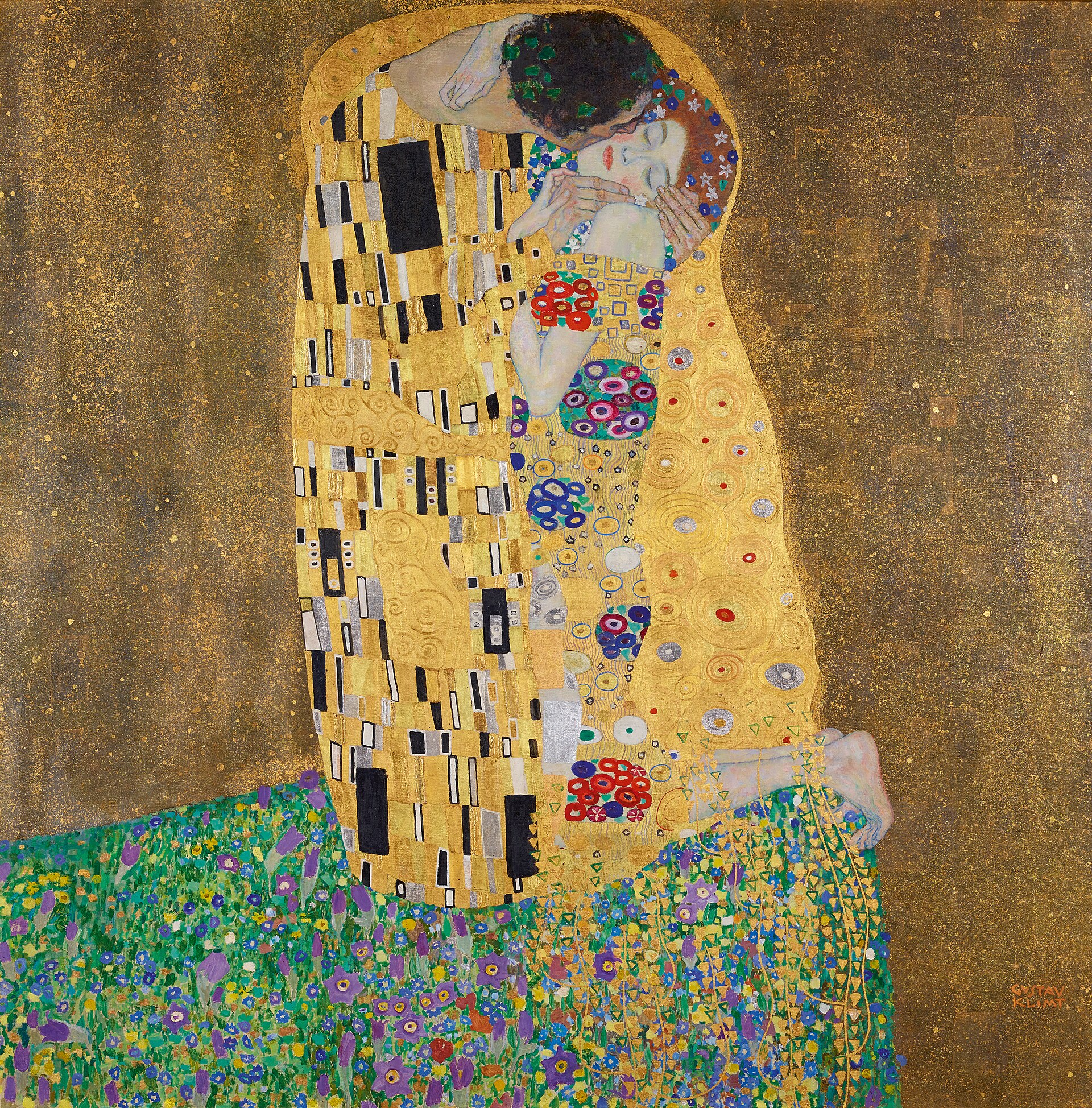
- What describes a person vs. a pattern? Look closely at the heads, shoulders, and hands. Notice how realistically the skin and facial expressions are rendered compared to the abstract cloaks.
- Gendered Geometric Language: Look at the man’s cloak (hard black, white, and gray rectangular blocks) versus the woman’s gown (soft colorful concentric circles, ovals, and floral disks). How does geometry distinguish the two lovers?
- The Golden Halo & Edge: Notice how the figures are cocooned inside a single massive golden silhouette that hovers over a precipice of wildflowers against a flat metallic background.
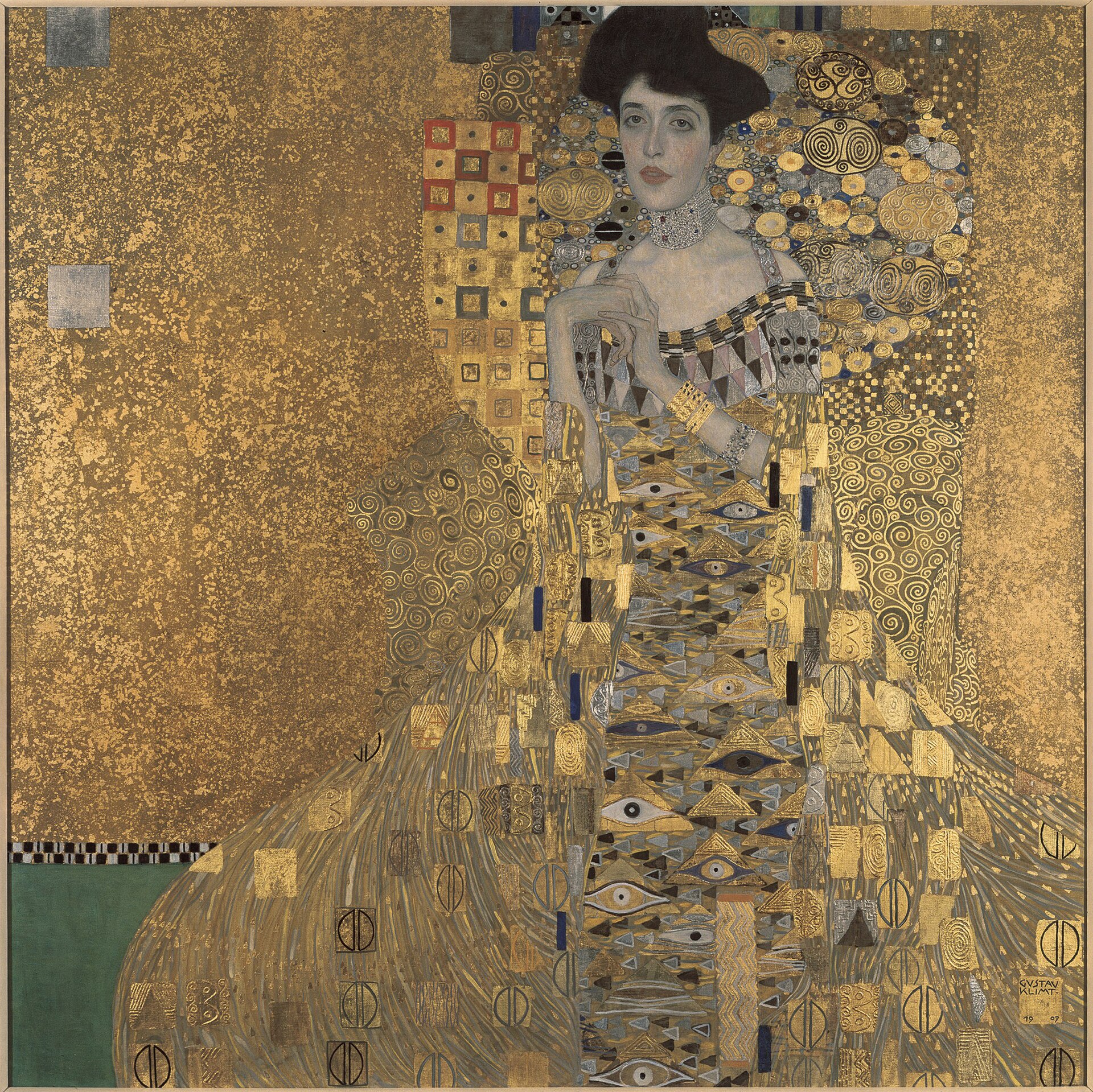
- The Threshold of Realism: Find the exact boundary where Adele’s naturalistic face, blushing cheeks, and slender clasped hands end and the jeweled gold surface begins.
- The Egyptian Eye Motifs (Udjat): Look across the golden dress for stylized triangular eye symbols, spirals, and checkerboards inspired by Byzantine and Egyptian iconography.
- Total Spatial Dissolution: Can you tell where Adele’s gown ends and the golden armchair or background wall begins? Klimt deliberately dissolves spatial boundaries into a shimmering mosaic tapestry.
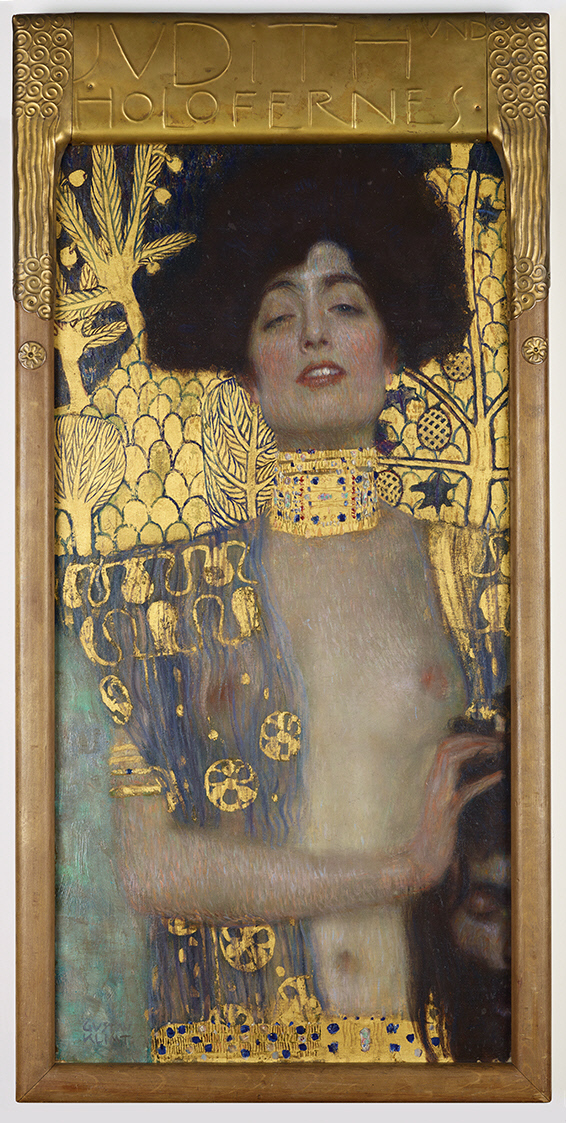
- Sensual Realism vs. Golden Relief: Observe Judith’s head tilted in ecstasy, her dark parted lips, and her softly modeled skin. How does her lifelike presence contrast against the flat embossed gold trees behind her?
- The Golden Choker as a Divider: Look at the heavy Art Nouveau gold-and-gem choker around her neck. Notice how it acts as an absolute graphic dividing line between her naturalistic throat and the rest of the canvas.
- The Hidden Narrative: In the lower right corner, notice the barely discernible hair and head of Holofernes emerging from the shadowy decorative hem.
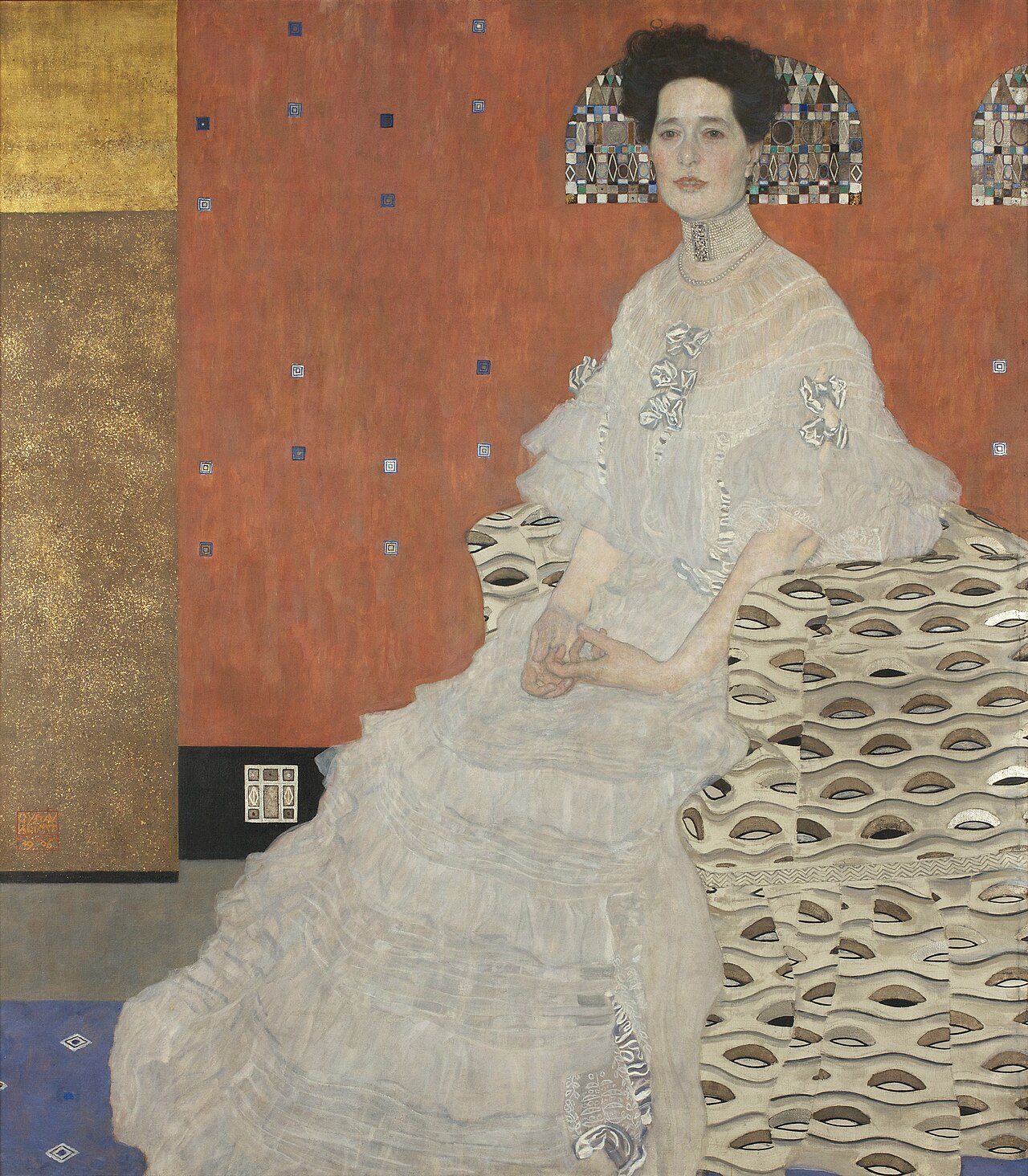
- The Stained-Glass Headrest: Behind Fritza’s exquisitely modeled porcelain head, observe the elaborate semicircular fan of stained-glass arcs and eye motifs that frames her like a modern secular halo.
- Checkerboard Secessionist Structure: Look at the chair armrests. Why did Klimt construct them out of sharp black, white, and red checkerboard squares rather than realistic wood carving?
- Geometry as Architecture: Notice how decorative geometry here is not an afterthought—it forms the entire structural skeleton of the portrait.
Klimt's Visual Language: Four Core Modules
To master Klimt’s compositional thinking, analyze the four fundamental principles that govern his golden masterpieces.
1. Realism Inside Ornament
Klimt isolates naturalistic rendering in faces, hands, and bodies. By rendering eyes, lips, and fingernails with tender academic subtlety, he creates an emotional anchor that makes the surrounding abstract pattern feel deeply alive.
2. Geometric Rhythm
Repetition turns individual shapes into visual music. Klimt uses circles, rectangles, spirals, triangles, and alternating checkerboards to lead the eye across the canvas and establish symbolic contrasts (e.g. masculine angularity vs. feminine curvature).
3. Flatness vs. Depth
Klimt creates deliberate tension between three-dimensional form and a two-dimensional decorative plane. Figures are not placed inside a receding atmospheric room; they emerge from a flat, compressed tapestry of pattern.
4. Gold as Material
Gold is not merely yellow pigment. Klimt incorporated actual gold, silver, and platinum leaf. Metal leaf reflects ambient gallery light, changes color as the viewer moves, and turns the painting into a precious, tactile physical object.
Hands-On Studio Prompts: The Alchemist Practice
These studio prompts are not about copying Gustav Klimt. They translate his core principles of contrast, geometry, and precious surfaces into your own original artistic voice.
Figure in Pattern: The Realist Anchor
Paint or draw a person, animal, or self-portrait with as much realistic, three-dimensional detail as you like. Then surround the subject with a completely different visual language—geometric patterns, botanical symbols, or repeated marks. Ask yourself: Where does realism end? Where does ornament begin?
Three Shapes: Building Geometric Rhythm
Choose only three geometric shapes (e.g. a square, an arc, and a spiral). Construct an entire decorative background using only those shapes—repeating, rotating, scaling, and overlapping them. Place one organic, flowing form inside the pattern and observe how the geometric structure energizes the organic subject.
Your Own Golden Surface: Luminous Architecture
Create a composition using a metallic or luminous medium as a primary structural element (copper, silver leaf, gold gouache, bronze ink, or pearl). Do not use the metallic color merely as small decorative glitter—make it a major flat plane or silhouette. Ask: Does the metallic surface merely decorate the piece, or does it transform the physical presence of the entire artwork?
Realism Meets Abstraction: The Unblended Boundary
Paint one central focal area with soft, photographic realism. Paint the surrounding area using only bold, flat shapes and pure unmodeled color. Do not gradually blend or soften the boundary between the two zones—let the transition be crisp, intentional, and startling.
Interactive Masterwork Analyzer
Explore four authentic museum masterworks and toggle three analytical inspection layers to see how Klimt balances naturalistic anatomy, decorative geometry, and spatial compression.
Authentic, unretouched high-resolution museum reproduction from the Belvedere, Vienna collection.
The Master's Takeaway: The Poetics of Contrast
Klimt’s genius lies not in abandoning realism, but in elevating it through the power of its opposite.
Atelier Reflection Questions:
1. "What happens psychologically when something delicately realistic is nested inside something highly abstract and flat?"
2. "Which area of your own composition became more vibrant and expressive because of the intentional contrast between realistic rendering and decorative geometry?"
Academic Sources & Museum Credits
All artworks presented in this masterclass are authenticated masterworks by Gustav Klimt from Österreichische Galerie Belvedere, Vienna and the Neue Galerie New York.
| Artwork Title | Date & Medium | Dimensions | Collection / Inventory | Official Museum Source |
|---|---|---|---|---|
| The Kiss (Der Kuss / Liebespaar) | 1907–1909, Oil, gold, silver, platinum leaf on canvas | 180 × 180 cm | Belvedere, Vienna • Inv. 912 | Belvedere Object 6678 → |
| Portrait of Adele Bloch-Bauer I (Woman in Gold) | 1907, Oil, gold and silver leaf on canvas | 138 × 138 cm | Neue Galerie New York | Neue Galerie Collection → |
| Judith I (Judith and the Head of Holofernes) | 1901, Oil and gold leaf on canvas | 84 × 42 cm | Belvedere, Vienna • Inv. 4737 | Belvedere Object 3492 → |
| Portrait of Fritza Riedler | 1906, Oil on canvas | 153 × 134 cm | Belvedere, Vienna • Inv. 3379 | Belvedere Object 2177 → |