Explore color, rhythm, line, shape, movement, and abstraction as visual equivalents of sound and feeling.
1. Look
→
2. Notice
→
3. Explore
→
4. Experiment
→
5. Create
1
The Big Idea: Paint Music & Pure Experience
Russian pioneer Wassily Kandinsky (1866–1944) helped fundamentally revolutionize modern art by pushing painting decisively toward abstraction. Instead of always painting recognizable physical objects, Kandinsky explored what could happen when color, line, shape, rhythm, and movement became the subject of the artwork itself.
Music was central to Kandinsky's entire creative universe. He experienced synesthesia—a sensory phenomenon where hearing sound stimulated vivid colors in his imagination, and seeing colors resonated like musical tones. He deliberately named his major painting series using musical terminology—such as Improvisations and Compositions—reflecting his conviction that visual art, like an orchestral symphony, could communicate directly with the human soul without needing to illustrate an external object.
The Central Questions: What Does Sound Look Like? • Can You Paint What Music Feels Like?
Kandinsky did not believe in a rigid mathematical code where every color has only one fixed emotion. Instead, he explored how dynamic relationships between lines, geometric forms, colors, and spatial tension evoke deep emotional and spiritual experiences. As an artist, you have the creative freedom to construct your own visual language.
The core lesson of Kandinsky's vision is liberating: You don't always have to paint a thing. You can paint an experience. You can paint movement. You can paint rhythm. You can paint sound. You can paint a feeling.
2
Look Closely: Five Authentic Wassily Kandinsky Masterworks
Examine five verified masterpieces spanning Kandinsky's pioneering path from early lyrical abstraction to mature Bauhaus geometric harmonies. Notice how each work translates tempo, timbre, chords, and rhythmic pulses into pure visual energy.
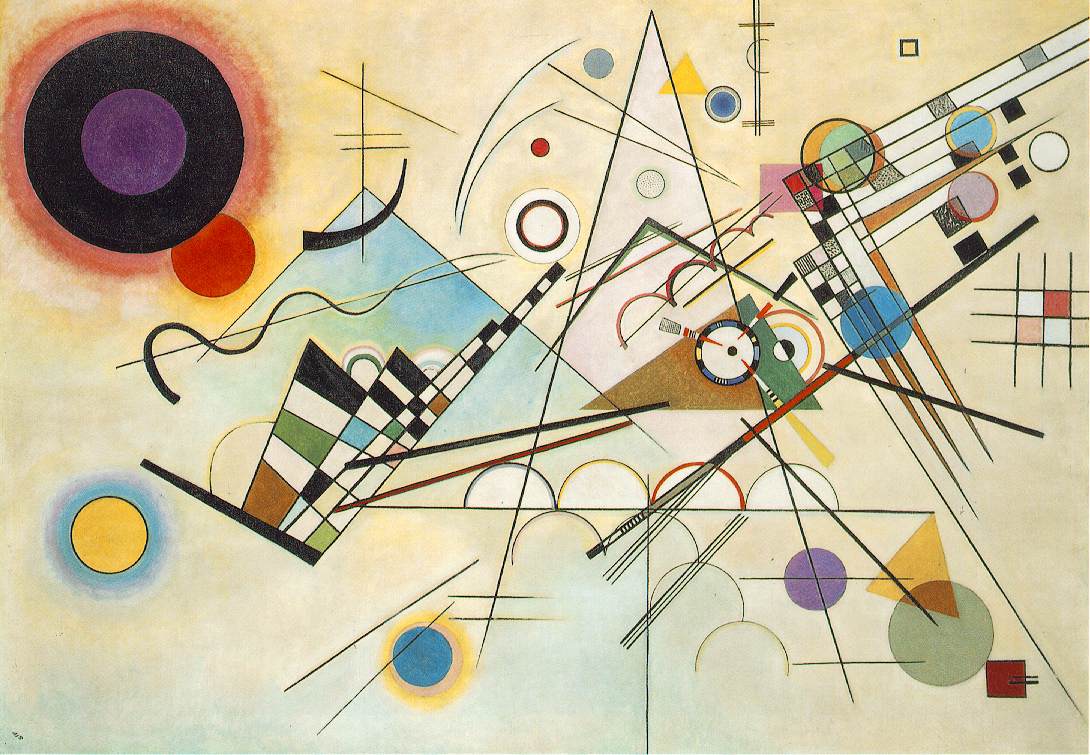
Composition 8
Wassily Kandinsky • July 1923 • Oil on canvas • 140 × 201 cm • Guggenheim NY 37.262
Composition 8 orchestrates circles, triangles, intersecting lines, checkerboards, and geometric arcs into an exhilarating visual symphony. If you could hear this painting, what would it sound like? Notice the dramatic visual rhythm: large dark circles anchor deep bass notes, while sharp radiating triangles and buzzing checkerboard grids shimmer like brass fanfares and percussion. Scale, direction, contrast, and movement invite each viewer to imagine their own musical interpretation.
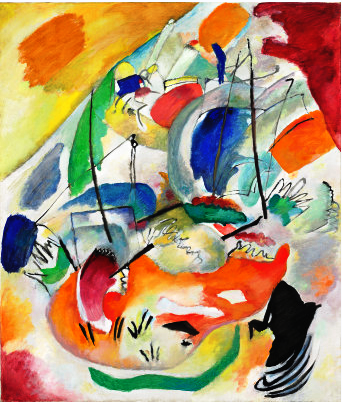
Improvisation 31 (Sea Battle)
Wassily Kandinsky • 1913 • Oil on canvas • 140.7 × 119.7 cm • National Gallery of Art 1978.51.1
Teaching Focus: Abstraction + Movement + Color + Recognizable Fragments
This monumental pre-war canvas proves an essential principle: abstraction does not have to mean nothing is recognizable. Look closely and you will discover sails, tall ship masts, billowing cannon smoke, and turbulent ocean waves colliding in dynamic apocalyptic motion. Kandinsky lets external reality and internal sensation overlap, using swirling brushstrokes and clashing color chords to convey chaotic energy and kinetic storm.
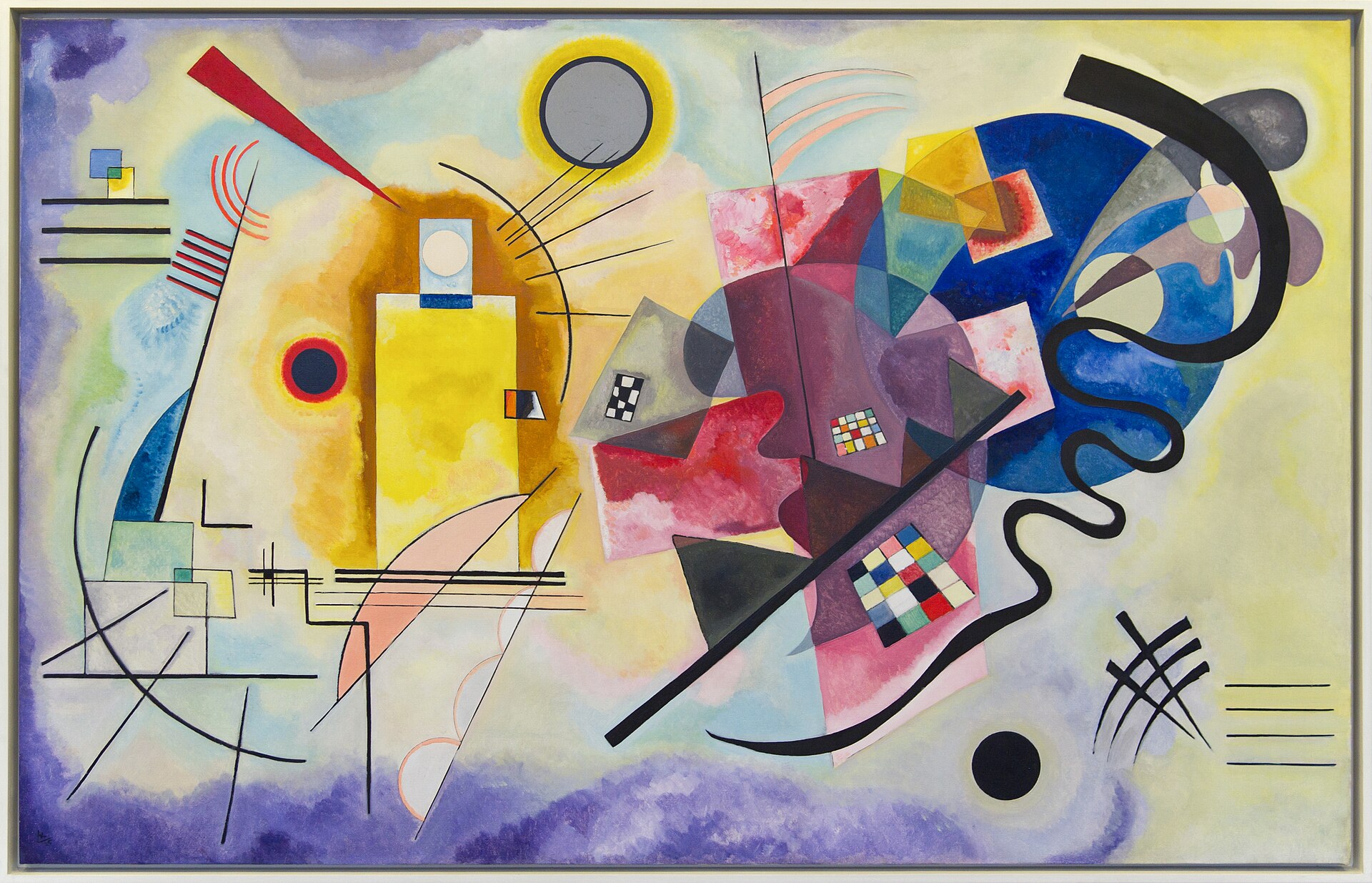
Yellow–Red–Blue (Jaune–Rouge–Bleu)
Wassily Kandinsky • 1925 • Oil on canvas • 128 × 201.5 cm • Centre Pompidou AM 1976-857
Teaching Focus: Color + Balance + Contrast + Geometric Language
Painted during his Bauhaus tenure, this work divides into two contrasting yet balanced visual movements: on the left, sharp rectilinear geometry, bright luminous yellow, and airy vertical lines; on the right, dark organic curves, a deep blue circle, and serpentine black contours. This illustrates that color does not just fill a shape—color can change the energy of the entire composition.
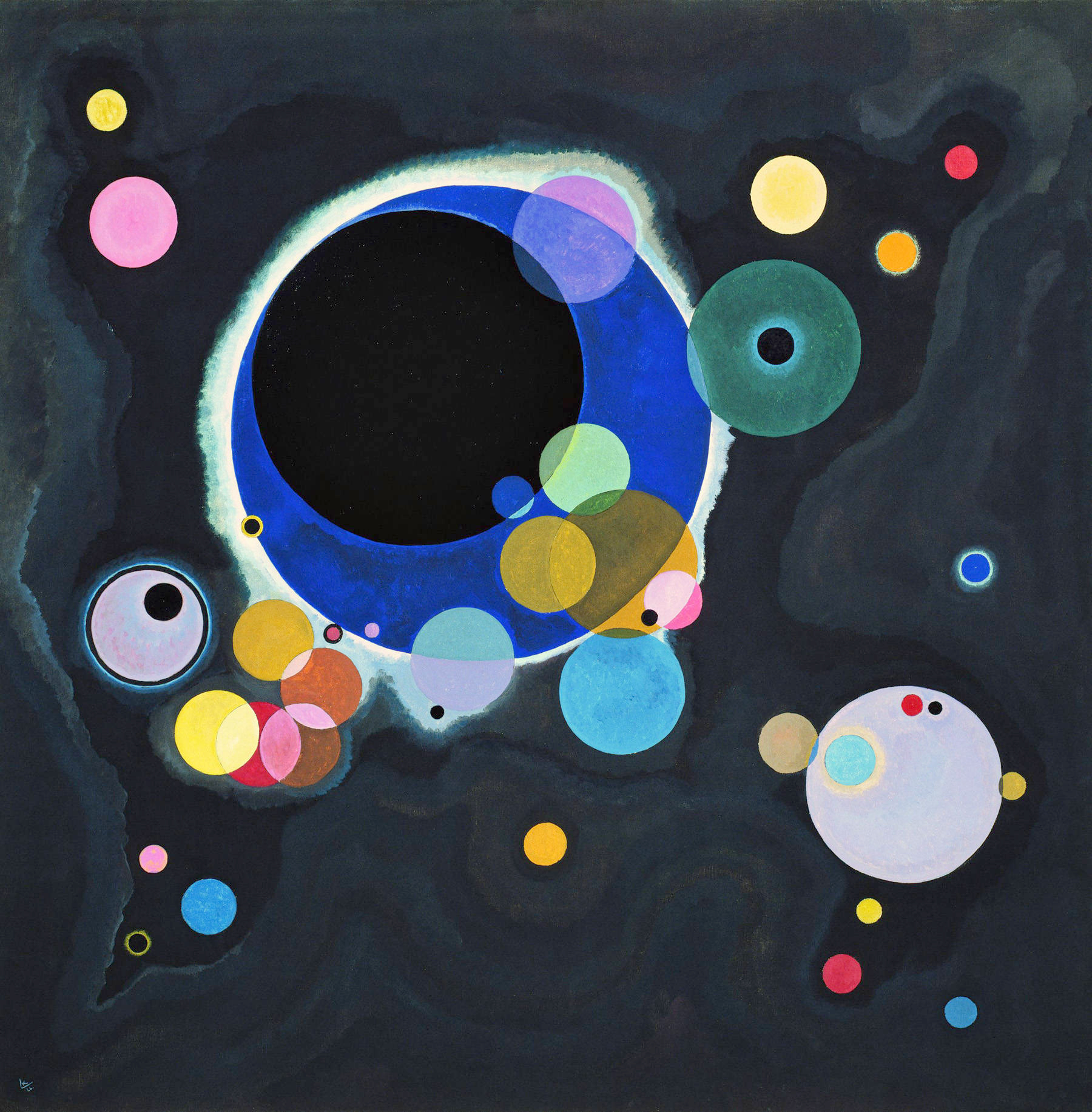
Several Circles (Einige Kreise)
Wassily Kandinsky • 1926 • Oil on canvas • 140.3 × 140.7 cm • Guggenheim NY 41.283
Teaching Focus: Repetition + Rhythm + Scale + Space
Floating across a deep, cosmic dark ground, circles of varying sizes, glowing halos, and delicate transparencies overlap like planetary orbits or sustaining musical notes. In musical rhythm, beat → beat → beat becomes circle → circle → circle. By varying diameter, color density, and spatial intervals, Kandinsky creates a hypnotic, meditative visual tempo that feels weightless and eternal.
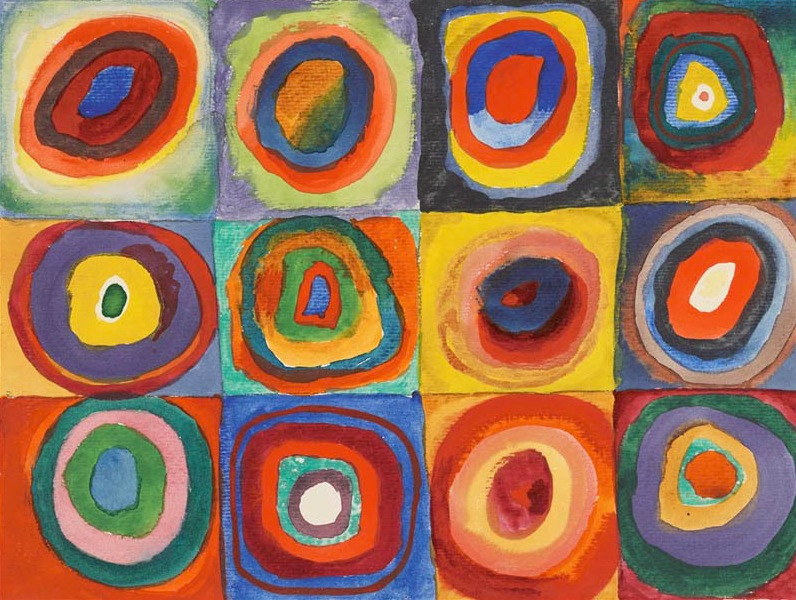
Teaching Focus: Color Relationships + Repetition + Pattern
In this world-famous analytical grid, Kandinsky systematically tests how concentric color rings interact when placed side-by-side inside twelve square compartments. Notice how repetition guides the viewer's gaze across the grid in a bouncing, melodic cadence without relying on any representational subject.
3
Three Things to Notice
When observing Kandinsky’s compositions, we can identify three core foundational principles that connect sight to sound:
🥁
1. Rhythm (Repetition = Visual Rhythm)
Repeated lines, circles, dots, geometric shapes, or color marks create a palpable visual beat.
The Beat: You control the tempo by altering size, spacing, direction, color intensity, density, and shape. Dense tight marks accelerate the tempo; wide intervals slow it down into calm stillness.
〰️
2. Movement (Directing the Eye)
A painting is not stationary—it guides the viewer's eyes through space with directional energy.
Visual Trajectory: Diagonal lines inject dynamic momentum, sweeping curves create fluid melodies, large shapes slow the gaze down to pause, while clusters of tiny marks generate visual vibration.
🎨
3. Color (The Instrument of Sensation)
Color is the visual equivalent of musical timbre and emotional vibration.
Your Color Language: A hue can feel warm, icy, loud, whispering, heavy, weightless, joyful, or tense depending on its neighboring chords. You get to define what each color communicates.
4
The Visual Translation System: Sound to Sight
How does an artist translate the invisible qualities of music into tangible visual choices? Use this translation framework as your creative launchpad (these are imaginative starting points, not rigid formulas):
Rhythm → Repetition
Pulse
Repeated musical beats translate into recurring visual elements:
Repeated concentric circles or dots
Rhythmic parallel lines or cross-hatching
Cadenced geometric patterns across the plane
Tempo → Spacing
Speed
The speed and pace of the sound govern the spatial intervals:
Fast tempo: Tightly packed marks, energetic clusters
Slow tempo: Generous open space, long visual pauses
Volume → Scale
Loudness
The acoustic power determines physical size and contrast:
Fortissimo (Loud): Massive shapes, bold strokes, high contrast
Pianissimo (Quiet): Delicate lines, small marks, gentle shifts
Pitch → Position
Altitude
The frequency and register of tones dictate vertical placement:
High pitches (Flute, Violin): Light forms soaring upward
Low pitches (Bass, Tuba): Heavy, deep forms anchored low
Timbre → Texture
Quality
The distinctive character and texture of an instrument:
Sudden acoustic transformations become striking visual contrasts:
Small → explosive large expansion
Whispering thin lines → heavy bold impasto strokes
Muted atmospheric wash → blazing saturated color accents
5
The Alchemist Artist: Paint Music
Now it is time to step up to your canvas, sketchbook, or digital easel and create your original musical abstraction.
The Core Studio Challenge
“What Does Sound Look Like?”
Choose a piece of music—classical, jazz, instrumental, cinematic, electronic, a favorite song, or natural sounds like rain, waves, wind, or birdsong. Do NOT paint what the song is literally about. Instead: Paint what the music feels like.
✦ Step 1 — Listen (With Closed Eyes)
Play your chosen music once with your eyes closed. Do not pick up a pencil or brush yet. Focus entirely on your sensory perception:
What emotional sensation washes over you?
Does the music feel heavy, grounded, or weightless?
Is the movement fast or slow? Smooth and flowing, or jagged and sharp?
Does it repeat in cycles? Does it rise into the sky or sink into depth?
What specific colors begin to glow in your mind's eye?
✦ Step 2 — Choose Your Visual Language
Map your auditory observations into your own distinct visual toolkit:
Palette: Pick 2–3 dominant colors and 1 high-contrast accent hue.
Line Style: Decide between sharp angular diagonals, soft rhythmic curves, or bold geometric verticals.
Rhythm & Scale: Determine how marks repeat, cluster, expand, or dissolve.
✦ Step 3 — Paint the Sound
Begin painting in direct response to the track playing in your space. Let your brushstrokes match the rhythm and momentum of the audio. Do not worry about rendering recognizable figures or scenes—let the painting become the music itself.
6
Optional Memory Version & The Alchemist's Symphony
Option B: Paint a Memory Through Music
Think of a poignant personal memory that carries a strong emotional charge. Select a piece of music that transports you back to that moment. Listen to the track and paint the memory as the music makes you feel it right now. You do not need to illustrate literal events or faces—paint the emotional atmosphere, symbolic fragments, light, and empty space.
The Alchemist's Symphony Challenge
When you are ready to construct a fully developed abstract masterwork, orchestrate these six structural visual voices together:
Color
Expresses emotional atmosphere and vibrational temperature.
Line
Expresses trajectory, momentum, speed, and directional melody.
Shape
Expresses individual instruments, tones, chords, and acoustic bodies.
Repetition
Expresses tempo, cadences, beats, and recurring refrains.
Space
Expresses silence, rests, pauses, and atmospheric breath.
Contrast
Expresses crescendos, sudden dynamic shifts, and harmonic tensions.
Kandinsky Gives Us the Tools. The Artist Creates the Language.
You don’t have to paint what something looks like. You can paint what it feels like. And with Kandinsky: You can even paint what you hear.
7
Atelier Reflection & Studio Inquiry
“Can you paint something you cannot see? If someone couldn't hear your music, could they still feel something of it by looking at your painting?”
Critique your finished musical abstraction through these seven reflective studio questions:
1. Visual Sound: What did your music sound like visually?
2. Color Language: Which colors did you choose, and why?
3. Rhythm: What created the rhythm?
4. Movement: Where does the viewer's eye move?
5. Silence: Where did you create silence?
6. Dynamic Shift: What part of the painting changed when the music changed?
7. Essence: Did you paint what the music was ABOUT, or what the music FELT LIKE?
8
Academic Sources & Museum Credits
The Alchemist Artists Master Artist Series uses authentic reproductions and verified collection records from the world's leading public cultural institutions. All links open directly to the specific artwork record: