Katsushika Hokusai: Calligraphic Contours & Bokashi
Analyze Japanese Edo-period Ukiyo-e woodblock principles: bold graphic keylines, flat harmonious color fields, and smooth tonal wipe transitions.
The Big Idea: The Poetry of Graphic Distillation
When Edo-period woodblock prints arrived in late 19th-century Europe, they caused an intellectual shockwave known as Japonisme. Master painters like Monet, Degas, and Van Gogh realized that Western academic painting had trapped itself in heavy chiaroscuro and photographic detail. Hokusai proved that you can create breathtaking emotional power by simplifying reality into expressive line and clean color fields.
Living Calligraphic Keylines
In Ukiyo-e printmaking, the master keyblock carves the black sumi ink lines. Unlike static tracing outlines, Hokusai’s contours vary dynamically in weight, tapering, and kinetic curvature to suggest wind, water, muscle, and timber tension.
Harmonious Flat Planes
Separate cherry wood blocks are carved for each discrete pigment. Flat areas of Prussian blue (bero-ai), terracotta red, and ochre establish instant structural clarity across the composition without muddy middle-value confusion.
Artisanal Gradations
Printers dampened the woodblock and gently wiped the pigment edge with a moist cloth (fukin) before pressing with the bamboo baren. This produced seamless atmospheric transitions without sacrificing crisp graphic silhouettes.
Look Before You Read: Four Masterwork Studies
Before reading technical analysis, train your eye on these authentic, high-resolution prints from The Metropolitan Museum of Art Open Access Collection. Dedicate 15–20 seconds of silent observation to each work.
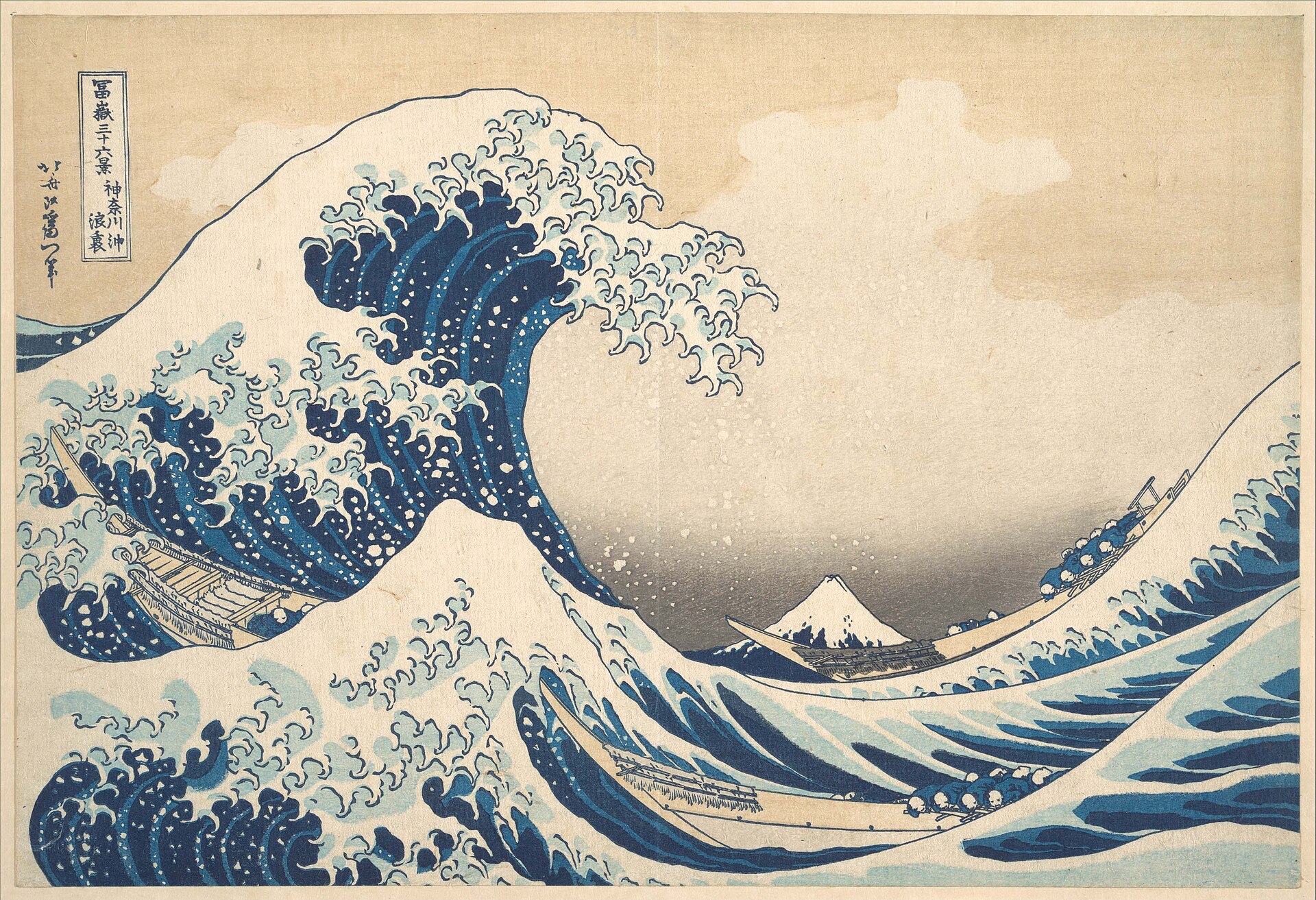
- The Parabolic C-Curve: Follow the immense sweeping arc of the wave from bottom-left to top-center. How does the line accelerate as it curls into claw-like foam fingers?
- Scale Inversion: Notice Mount Fuji in the deep background. Why did Hokusai frame the sacred, immortal volcano as a tiny triangle sheltered beneath a temporary wall of violent water?
- Flat vs. Graded Blue: Observe where the Prussian blue is printed as a solid flat field versus where it softens into light blue foam.
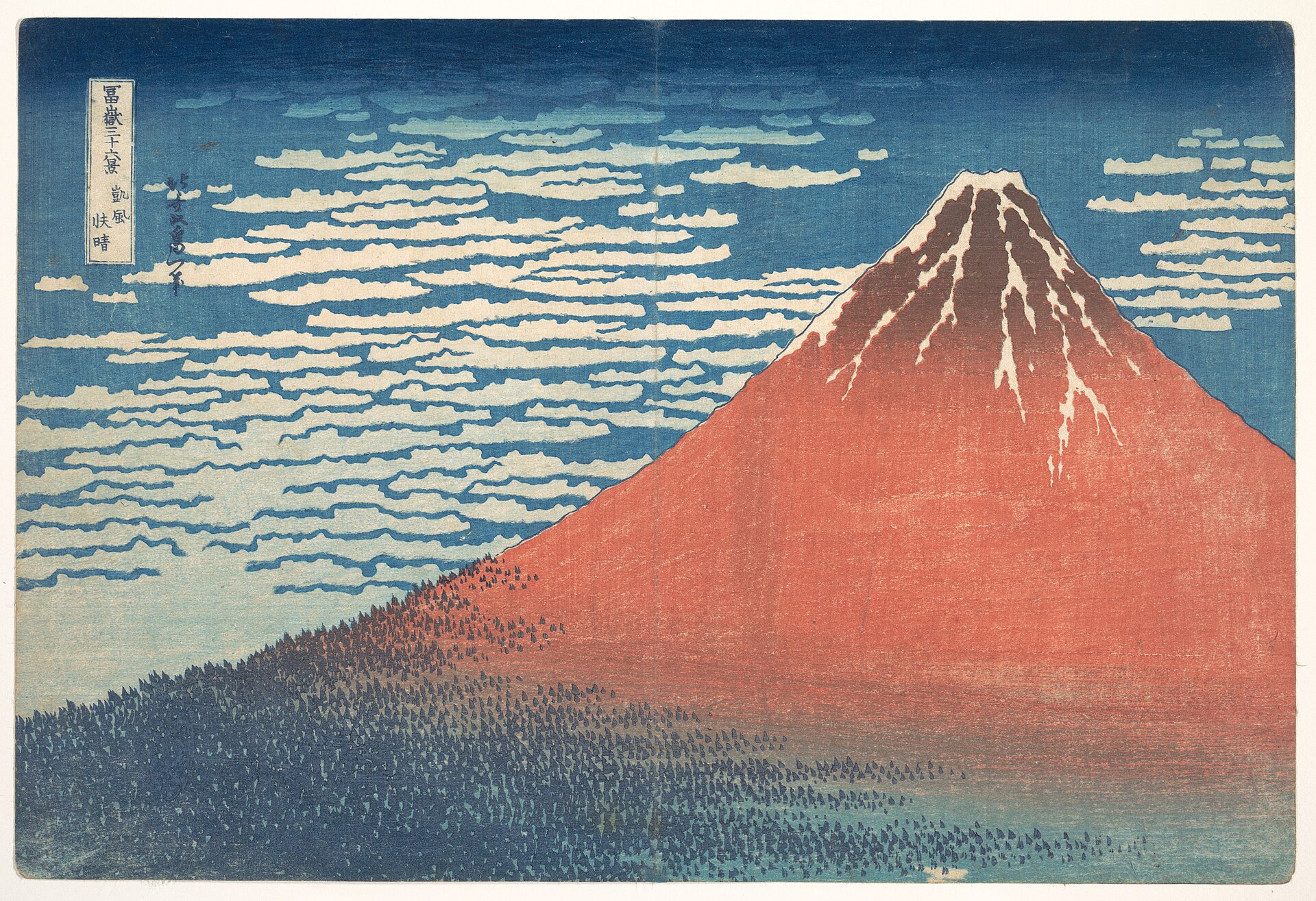
- Color Plane Vibrancy: Look at how the terracotta red of the sunlit mountain slope vibrates against the deep Prussian blue sky without a single blended brushstroke between them.
- Horizontal Mackerel Clouds: Notice the rhythmic floating cloud bands (iwashigumo). How do their flat, graphic bars create immense spatial depth against the vertical climb of the peak?
- Linear Snow Fissures: Study the delicate white dendritic lines carving into the summit crater. How do they communicate steep rocky crevices with pure calligraphic elegance?
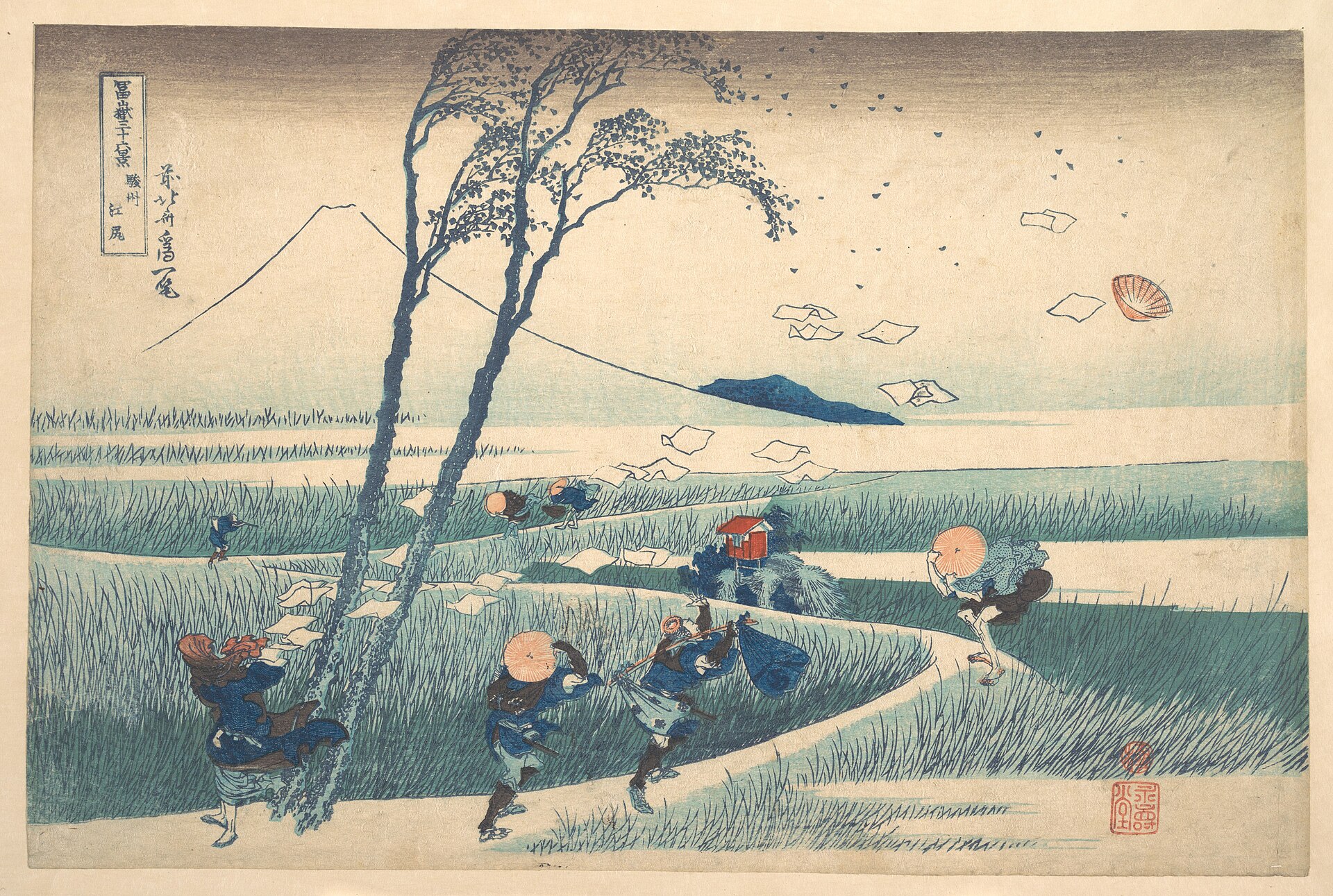
- Painting the Invisible Wind: Wind is invisible, yet you feel its immense velocity instantly. Look at how Hokusai uses flying hats, scattering tissue sheets (kaishi), and whipped willow branches to describe kinetic air pressure.
- Human Gesture Under Strain: Observe the figures clutching their hats and cloaks. Every contour line bends with the directional force of the gale.
- Minimalist Mount Fuji: Look at the background volcano. It is drawn with a single, razor-thin unbroken keyline, standing silent and completely unaffected by the storm below.
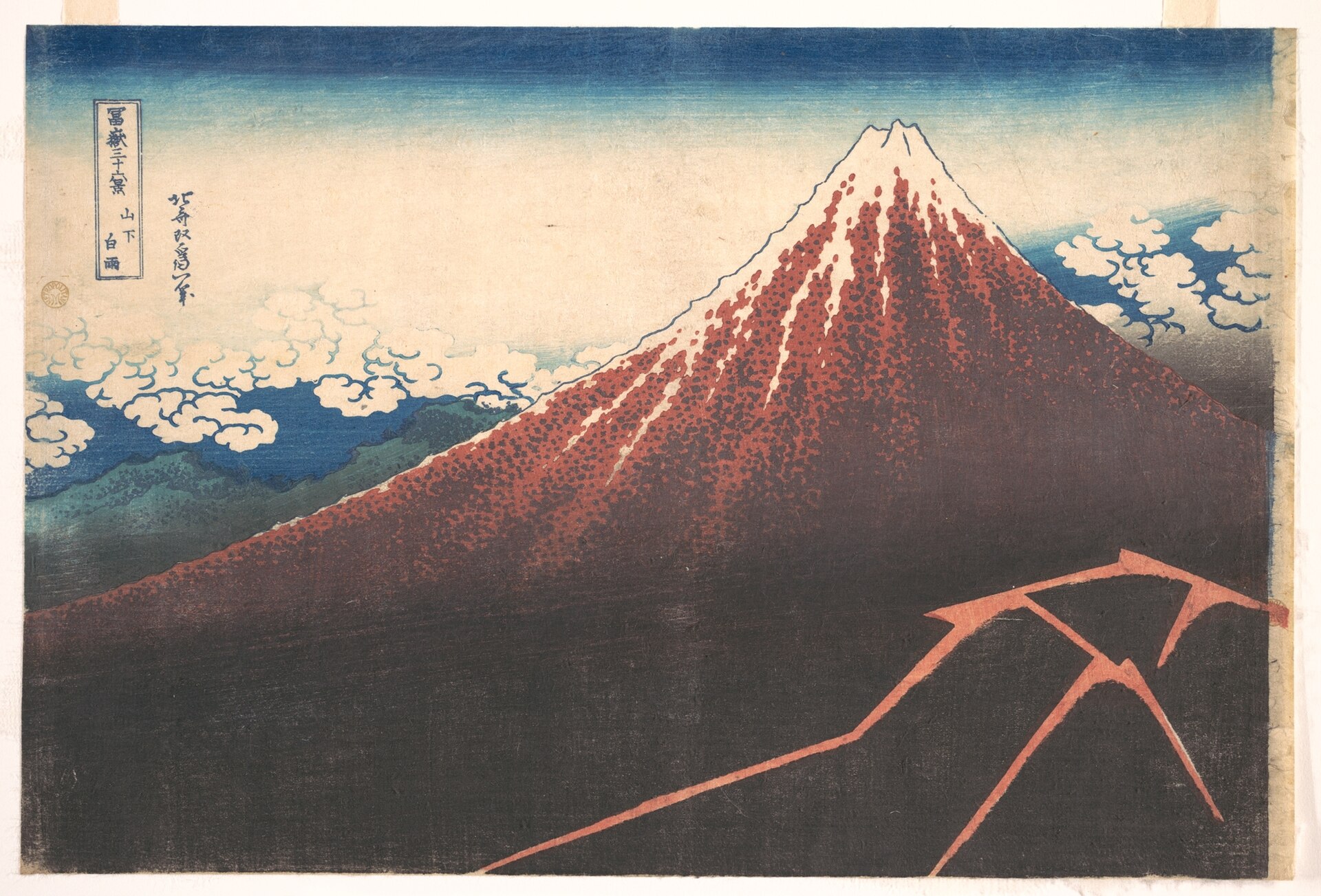
- The Split Atmospheric Horizon: The top half of the print basks in calm, clear morning sky, while the base is consumed by pitch-black thunderclouds.
- The Forked Lightning Strike: Observe the jagged vermilion/gold lightning keyline cracking across the pitch-black storm mass. How does its razor-sharp angle punctuate the dark silhouette?
- Deep Bokashi Wipe: Look at the lower right corner. The printer wiped ink progressively across the woodblock to achieve an impenetrable midnight shadow.
The 3 Ukiyo-e Design Pillars
To incorporate Hokusai's mastery into your own artwork, understand the three architectural principles that govern Edo-period composition.
Calligraphic Contour Dynamics
In Japanese painting, a line is never a dead boundary; it is a physical event with momentum. Lines swell where forms collide or turn into shadow, and taper to razor-sharp points where light releases them. Every line possesses directional intent.
Pure Harmonious Color Fields
Western painting often creates muddy transitions by constantly mixing intermediate grays. Hokusai establishes clean, bold color masses (Prussian blue, vermilion, ochre, pine green) that read with unmistakable graphic impact from across the room.
Bokashi: Atmospheric Tonal Wipes
Bokashi is not a digital airbrush; it is a deliberate, single-axis wipe across a carved plane. By placing a smooth tonal gradation in the sky or deep water, Hokusai establishes infinite atmospheric depth while preserving razor-sharp silhouettes.
Asymmetry & Scale Inversion
Instead of centering focal subjects, Hokusai forces massive foreground gestures (cresting waves, bending trees, rushing travelers) against distant immortal landmarks, creating dynamic diagonal tension and cinematic storytelling.
Hands-On Studio Exercise: The 6-Step Ukiyo-e Synthesis
Apply Hokusai’s design workflow to your own landscape, figure, or illustration project (digital or traditional ink and watercolor).
Establish Dynamic Kinetic Curves (Underdrawing)
Begin with 2–3 sweeping kinetic vectors across the page. Whether sketching a mountain ridge, crashing surf, or city street, find the dominant C-curve or S-curve that drives the eye diagonally across the frame.
Carve the Living Calligraphic Keyline
Ink your contours with conscious pressure modulation. Allow the brush or stylus to widen at corners, overlaps, and wave crests, and taper cleanly on leading edges. Avoid mechanical, uniform strokes.
Block in 3–4 Flat Value Masses
Fill major areas with flat, solid color planes without shading. Limit your initial block-in to 3–4 harmonious tones (e.g. deep indigo, terracotta red, buff paper, pine green). Ensure shapes read clearly as distinct silhouettes.
Execute Directional Bokashi Wipes
Add atmospheric depth with smooth, directional tonal wipes across 1–2 key fields (such as the top margin of the sky or the base of a mountain). Keep the transition clean and avoid scattering soft airbrush textures across flat shapes.
Detail with Rhythmic Graphic Accents
Add decorative rhythmic accents to bring the surface alive: claw-like foam droplets, floating cloud strips, fluttering leaves, or delicate snow fissures. Repeat shapes rhythmically to generate visual music.
Unify and Balance Foreground vs. Horizon
Step back and verify your spatial hierarchy. The high-energy foreground calligraphic marks should contrast harmoniously against a calm, simplified horizon plane, giving the composition both power and stillness.
Interactive Masterwork Analyzer
Switch between four authentic Met Museum masterworks and toggle three analytical inspection layers to see calligraphic vectors, flat color planes, and bokashi tonal wipes mapped directly onto the historical prints.
Authentic, unretouched high-resolution museum scan from The Metropolitan Museum of Art Open Access Collection.
The Master's Takeaway: Designing with Line & Void
Katsushika Hokusai lived to age 88, continually reinventing his draftsmanship. On his deathbed, he famously declared: "If only Heaven had granted me five more years, I would have become a real painter."
What made Hokusai eternal was his refusal to become a passive recorder of reality. He taught that every line you draw must contain life, every color mass must hold structural clarity, and atmosphere should be summoned through disciplined gradation rather than accidental clutter. Whether working with physical sumi ink, watercolor, oil paint, or digital software, embrace Hokusai’s philosophy: distill the essence of nature, and let your contours breathe.
Academic Sources & Met Museum Open Access Credits
All artworks presented in this lesson are authenticated Edo-period polychrome woodblock prints from The Metropolitan Museum of Art Open Access Collection, published in accordance with public domain educational guidelines.
| Artwork Title | Date & Medium | Dimensions | Collection / Accession | Met Open Access Source |
|---|---|---|---|---|
| Under the Wave off Kanagawa (The Great Wave) | ca. 1830–32, Polychrome woodblock print | 10 1/8 x 14 15/16 in. (25.7 x 37.9 cm) | The Metropolitan Museum of Art, JP2569 | Met Object 39799 → |
| South Wind, Clear Sky (Red Fuji / Gaifū kaisei) | ca. 1830–32, Polychrome woodblock print | 10 1/8 x 15 in. (25.7 x 38 cm) | The Metropolitan Museum of Art, JP9 | Met Object 36490 → |
| Ejiri in Suruga Province (Sunshū Ejiri) | ca. 1830–32, Polychrome woodblock print | 10 1/8 x 14 7/8 in. (25.7 x 37.8 cm) | The Metropolitan Museum of Art, JP2953 | Met Object 55735 → |
| Storm Below Mount Fuji (Sanka no haku u) | ca. 1830–32, Polychrome woodblock print | 9 7/8 x 14 5/8 in. (25.1 x 37.1 cm) | The Metropolitan Museum of Art, JP11 | Met Object 36492 → |