Explore how hyper-realistic academic precision, dream physics, and impossible juxtapositions transform wild imagination into undeniable, tangible visual reality.
1. Real Masterwork
→
2. Look Closely
→
3. Understand Decisions
→
4. Discover Principles
→
5. Experiment in Lab
→
6. Create Original
1
The Big Idea: Making the Impossible Tangible
What makes the Surrealist paintings of Salvador Dalí (1904–1989) so instantly captivating across generations? It is not merely that his ideas are strange, unexpected, or dreamlike. What makes Dalí's work hypnotic is the radical contrast between impossible subjects and uncompromising academic realism.
Dalí famously described his paintings as “hand-painted dream photographs.” If an artist draws a melting clock loosely or sketchily, the viewer perceives it merely as a cartoon, fantasy, or stylistic doodle. But when Dalí paints a limp watch draped across an olive branch, he renders every metallic glint, every razor-sharp specular highlight, every subtle cast shadow, and every millimeter of atmospheric falloff with the precision of a 17th-century Dutch master.
The Central Question: What If Your Imagination Followed the Rules of Reality?
Dalí understood a profound secret of visual psychology: the human brain believes impossible things when they are rendered with physically believable optical rules. By grounding impossible concepts in consistent lighting, tangible surface textures, and strict linear perspective, the impossible ceases to look like a trick—it feels like a real world you could step inside.
To master Dalí’s approach, we do not copy his specific iconography (such as melting watches, drawers, or crutches). Instead, we study the three foundational pillars of Surrealist illusion:
1. Classical Academic Precision: Razor-sharp edge control, mirror-smooth blended gradients, and authentic material textures (wood, metal, stone, glass, skin).
2. Dream Physics & Inverted Properties: Solid objects behaving like soft liquids, architecture defying gravity, and massive structures balanced on microscopic needle points.
3. Radical Juxtaposition: Forcing completely unrelated objects from different worlds into a single, cohesive, believable space where they must interact.
2
Look Closely: Four Authentic Dalí Masterwork Studies
Before we create our own work, we must observe how Dalí orchestrated composition, light, and materiality across four authentic painting masterworks. Examine each work closely through our four-part analytical framework.
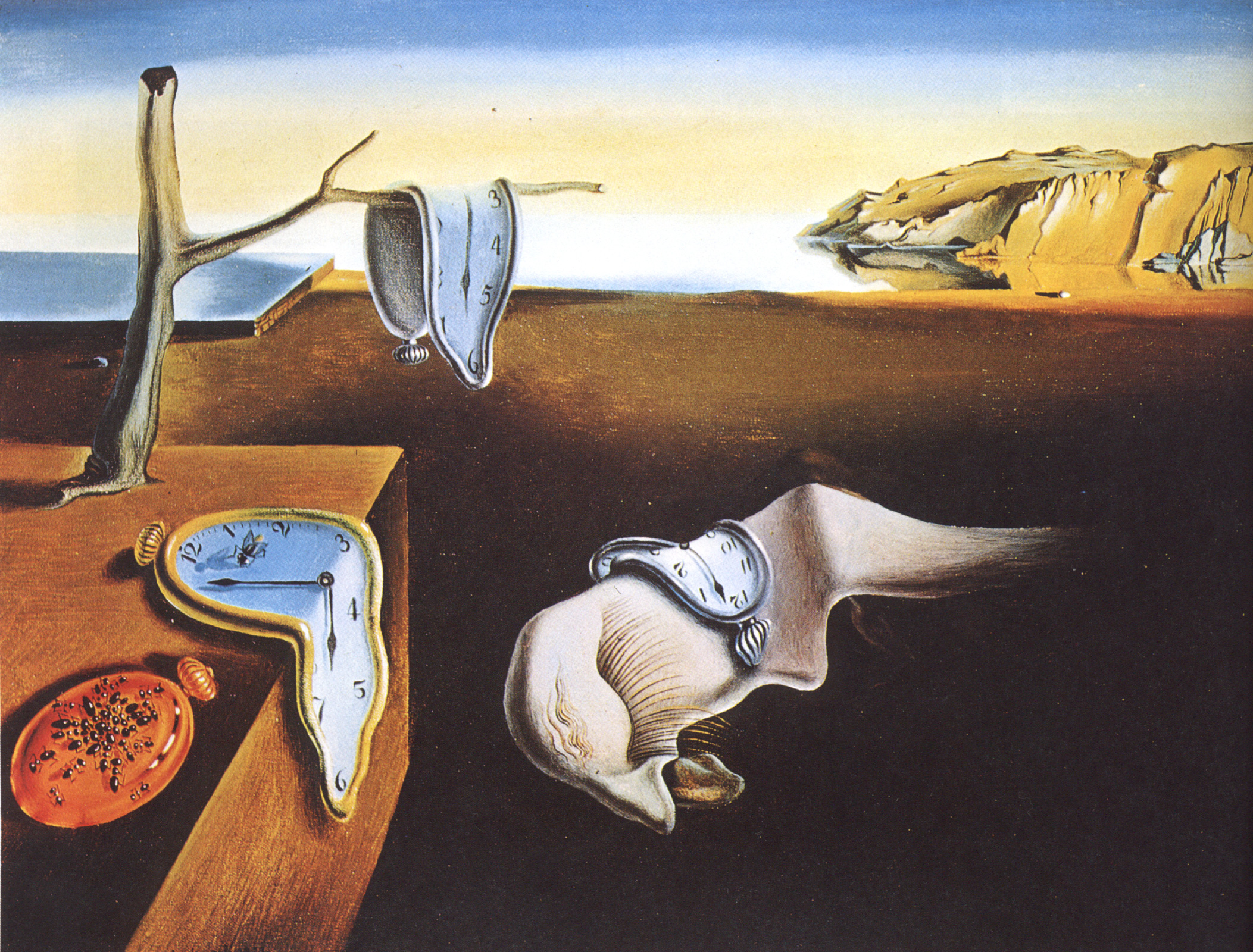
The Persistence of Memory
Salvador Dalí • 1931 • Oil on canvas • 24.1 × 33 cm (9 ½ × 13 in.) • MoMA 162.1934
Three limp, molten pocket watches draped across a wooden table block, a dead olive branch, and a sleeping organic face, surrounded by an infinite Catalan coastal desert and rocky golden cliffs.
⚙ What Did Dalí Do?
He inverted the fundamental property of timepieces: instead of rigid gold and glass, they hang like soft cheese or wet fabric, while maintaining exact numerals, watch hands, and metallic rims.
💡 Why Does It Work?
The single directional sunlight casts dark, razor-sharp shadows at a uniform angle across the beach. The golden cliffs in the distance provide a monumental, silent contrast to the miniature foreground objects.
🎨 What Can I Try?
Take an extremely rigid, hard-edged manufactured tool (a key, a smartphone, a ruler) and paint it as though it were made of soft warm wax or draped silk over the edge of a table.
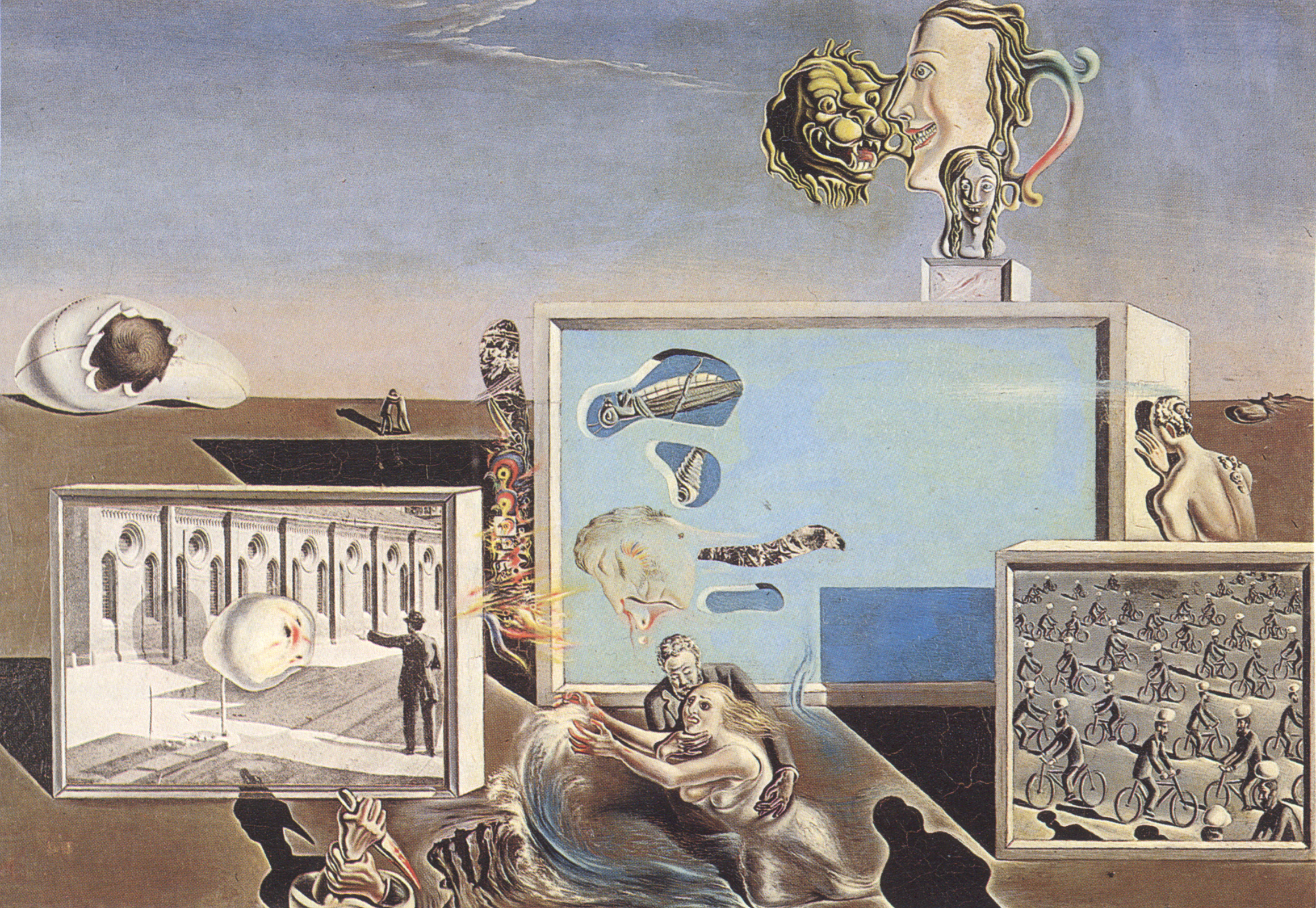
Illumined Pleasures
Salvador Dalí • 1929 • Oil and mixed media collage on composition board • 23.8 × 34.7 cm • MoMA 584.1967
Three glowing miniature shadow boxes / cinema screens sit in an expansive plain, each displaying violent, theatrical, and mysterious narrative vignettes surrounded by colliding symbols.
⚙ What Did Dalí Do?
He constructed nested, picture-in-picture realities. By embedding framed windows inside an open landscape, he fractures narrative space and forces the viewer to observe private subconscious chambers.
💡 Why Does It Work?
The warm theatrical stage lighting emanating from the screens cuts through the cool twilight sky, creating intense focal points and miniature worlds within worlds.
🎨 What Can I Try?
Paint a desolate landscape and place a small framed glowing doorway or shadow box in the center showing an entirely different climate or interior scene.
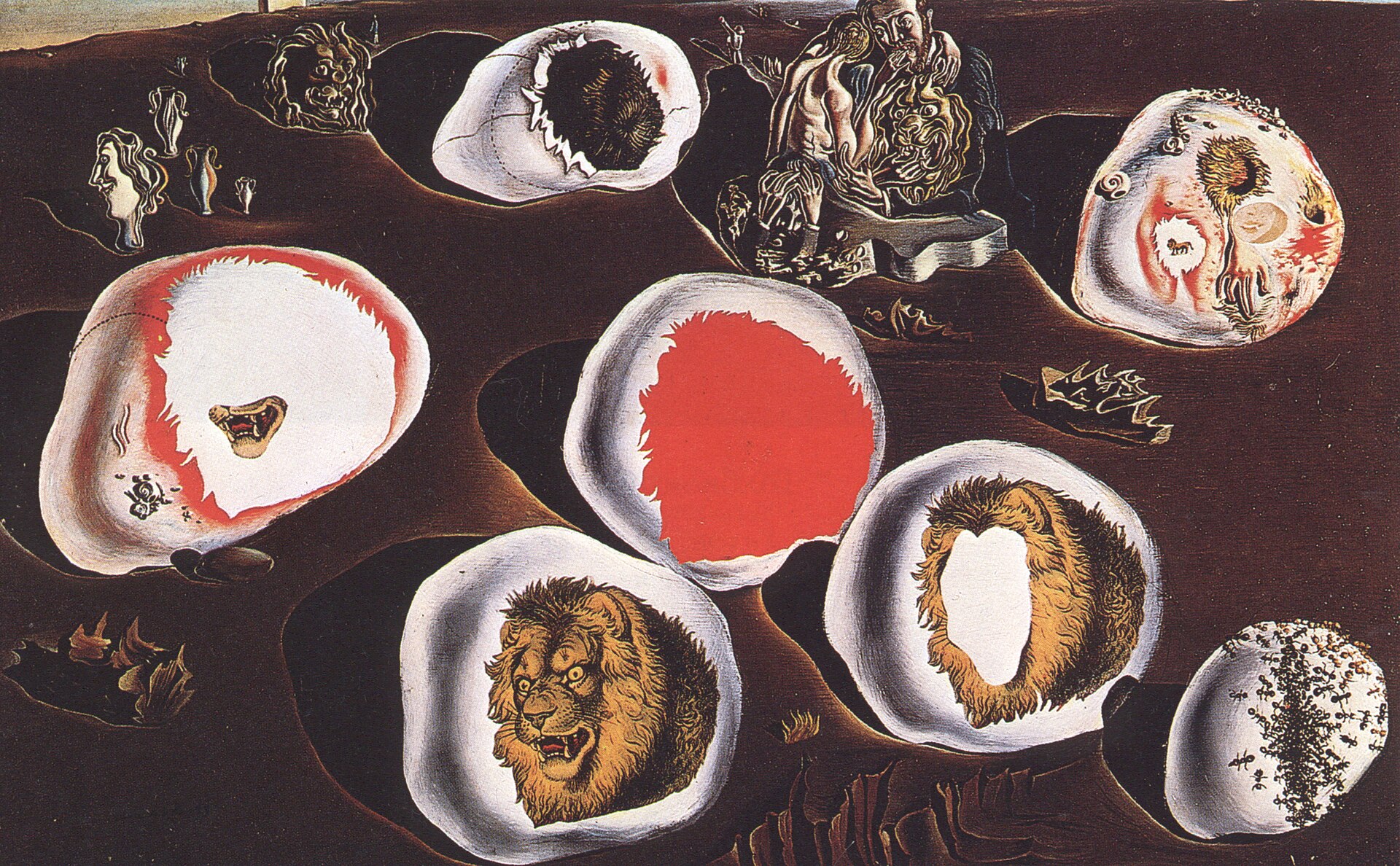
The Accommodations of Desire
Salvador Dalí • 1929 • Oil and collage on wood • 22.2 × 34.9 cm (8 ¾ × 13 ¾ in.) • Met 1999.363.16
A series of oversized, polished floating river pebbles scattered across a golden desolate plain, several bearing painted and collaged lion heads, swarming ants, and shadowy figures.
⚙ What Did Dalí Do?
He turned inert mineral river stones into living psychic display screens, mapping ferocious predator expressions and biological decay seamlessly onto smooth, egg-like surfaces.
💡 Why Does It Work?
The razor-sharp curvature highlights on the polished pebble skins and their crisp, elongated ground shadows make these impossible floating stones feel physically heavy and tangible.
🎨 What Can I Try?
Draw several smooth river stones or eggs casting clean directional shadows, and render unexpected textures, faces, or symbols wrapped around their curved volumes.
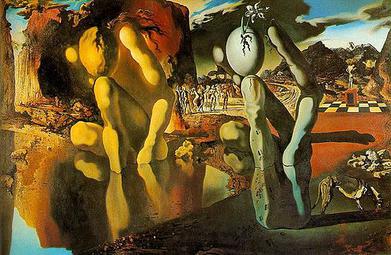
Metamorphosis of Narcissus
Salvador Dalí • 1937 • Oil on canvas • 51.1 × 78.1 cm (20 ⅛ × 30 ¾ in.) • Tate T02343
On the left, the crouching figure of Narcissus staring into water; on the right, his exact silhouette mirrored as a petrified stone hand holding a cracked egg with a sprouting narcissus flower.
⚙ What Did Dalí Do?
He pioneered the paranoiac-critical "double image," constructing two completely distinct visual subjects (human figure and stone hand) that share the exact same geometric silhouette and volume.
💡 Why Does It Work?
Consistent warm golden Catalan sunlight illuminates both forms from the same low angle, allowing the viewer's eye to transition effortlessly from human anatomy to cold stone.
🎨 What Can I Try?
Design a double-image composition where the outer contour of a living person or animal matches the exact silhouette of an inanimate natural object like a rock formation or tree.
3
Dalí's Surrealist Toolbox: 7 Core Principles
Surrealist art is not arbitrary randomness. Dalí operated with a precise visual vocabulary designed to subvert expectations while maintaining absolute optical credibility. Master these 7 core principles:
💧
1. Elastic Materiality
Swap the core physical property of an object. Make rigid brass soften like dough, or turn flowing ocean water into carved solid stone.
🔍
2. Radical Scale Shifts
Disrupt natural proportions. Magnify a microscopic ant to the size of a carriage, or shrink an entire city onto a desktop chess piece.
🪞
3. The Double Image
Construct two completely different subjects that share the exact same outer silhouette, allowing the eye to shift between living flesh and petrified stone.
🏜
4. Displaced Environment
Rip a familiar domestic object out of its room and isolate it in a vast, silent, infinite desert or coastal horizon under a twilight sky.
🏛
5. Material Metamorphosis
Show one substance gradually transforming into another—living flesh turning to marble columns, or clouds hardening into crystal tiles.
☀️
6. Believable Lighting
Keep a strict, single directional light source. Cast dark, elongated, sharp-edged shadows to ground every floating or distorted object firmly in space.
✨
7. Razor Specular Glazes
Render micro-reflections, glass highlights, and fine brush glazes. The sharper the reflection, the more the human eye believes the surface is physically real.
4
The Alchemist Surrealist Lab: 5 Guided Experiments
Do not copy Dalí's melting clocks. The true goal of an Alchemist artist is to develop your own impossible ideas using rigorous painting craft. Work through these 5 targeted studio experiments:
1
Exaggerate the Ordinary
Pick one ordinary object in your room (a coffee mug, a shoe, an apple). Keep 90% of its details hyper-realistic, but stretch one dimension by 500%.
2
Distort the Color
Paint a recognizable landscape with unnatural hues (obsidian water, violet sand, copper sky), but maintain rigorous value contrast and realistic shadows.
3
Change One Rule
Turn off one law of physics for one single object in your composition (e.g. make a heavy boulder float effortlessly two inches above a table).
4
The Metamorphic Double
Design a composition where the contour of a living form aligns with an inanimate object, creating a dual reading within a single shared shape.
5
Distort Time
Depict the passage of time on a static object: show rapid decay, crystallization, melting, or infinite freeze-frame stillness in a single frame.
The Alchemist Synthesis Challenge
Synthesize any three of the experiments above into one completely original artwork. Build a cohesive world with believable directional lighting, sharp edge control, and deep spatial perspective on your canvas or sketchbook.
5
Interactive Masterwork Analyzer
Examine the anatomical construction and optical illusion layers across four authentic Dalí painting masterworks. Switch between paintings and activate the analytical layers to reveal dream physics, edge precision, and spatial collisions.
Interactive Dalí Masterwork Analyzer16 Analytical States
Authentic high-resolution scan of Salvador Dalí's iconic Surrealist painting from The Museum of Modern Art collection (MoMA 162.1934).
Medium: Oil on canvas Dimensions: 24.1 × 33 cm (9 ½ × 13 in.) Location: The Museum of Modern Art, New York
6
Atelier Reflection & Creative Philosophy
“You don’t have to know what your artwork means before you make it. Start with curiosity. Change one thing. Then see what happens.”
Many students hesitate before beginning a surrealist artwork because they feel pressured to explain a complex subconscious allegory or hidden psychological meaning. But Dalí worked through intuitive discovery and obsessive technical mastery. When you render an impossible concept with genuine care and precision, the painting generates its own poetic mystery.
Sketchbook Inquiry & Self-Critique Questions:
Lighting Consistency: Did I establish a single, unambiguous light direction that casts convincing shadows for every impossible element?
Edge & Surface Control: Are my hard edges crisp and my soft gradients seamless enough to convince the eye of physical substance?
Restraint & Grounding: Did I leave enough quiet, realistic space (like a calm sky or solid table) so the impossible object stands out powerfully?
Originality of Concept: Did I invent an impossible rule of my own, rather than borrowing familiar melting clocks or tropes?
7
Academic Sources & Museum Credits
The Alchemist Artists Master Artist Series uses authentic reproductions and verified collection records from the world's leading public cultural institutions. All links open directly to the specific artwork record: