Modern Master Lesson

Francis Bacon: Distort the Figure

Explore expressive distortion, psychological tension, spatial framing, and the figure as a vehicle for emotion rather than perfect anatomy.

1. Look
→
2. Notice
→
3. Explore
→
4. Experiment
→
5. Create

1 The Big Idea: The Figure as a Vehicle for Sensation

British painter Francis Bacon (1909–1992) radically revolutionized figurative painting in the twentieth century. While traditional art history often prioritized anatomical accuracy, classical proportions, and flattering likenesses, Bacon abandoned surface illustration to capture what he described as the “brutality of fact”—the raw, nervous-system sensation of psychological and emotional existence.

The Central Question: What Sensation Are You Trying to Make Visible?

Bacon’s distortion was not about making the human figure look strange for the sake of shock. He understood that distortion can communicate emotion directly to the viewer's nervous system. A mouth can become exaggerated into a primal scream. A face can stretch, smudge, or dissolve into shadow. A torso can twist with violent energy, or a figure can be locked inside an invisible geometric space-frame to amplify isolation.

When studying Bacon, the student learns that DISTORTION CAN COMMUNICATE EMOTION. By making deliberate, expressive modifications to recognizable anatomy, an artist transforms a passive portrait into an emotionally charged encounter.

2 Look Closely: Seven Authentic Francis Bacon Masterworks

Examine seven authentic masterworks by Francis Bacon from leading museum collections. Observe how each painting uses distortion, surrounding spatial structures, and color to make internal human sensations visible.

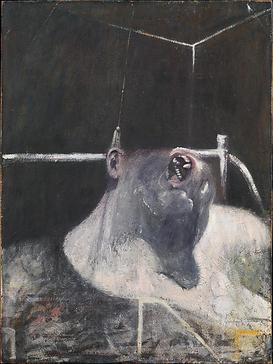
Head I by Francis Bacon, 1948, Metropolitan Museum of Art

Head I

Francis Bacon • 1948 • Oil and tempera on hardboard • 100.3 × 127 cm • Met 1999.363.1

View at The Met →
Teaching Focus: Distortion + Psychological Space

Bacon transforms the recognizable human skull and jaw into a visceral, open-mouthed grimace, while surrounding the form with thin, ghost-like orthogonal framing lines. Notice how these linear geometric boundaries create immediate claustrophobia and psychological confinement, trapping the distorted head inside an invisible cage.

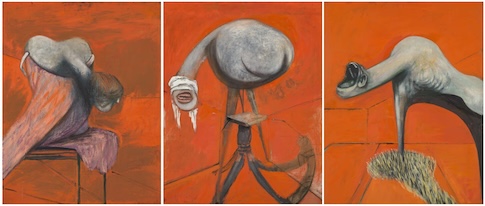
Three Studies for Figures at the Base of a Crucifixion by Francis Bacon, 1944, Tate Collection

Three Studies for Figures at the Base of a Crucifixion

Francis Bacon • 1944 • Oil on Sundeala board • 94 × 74 cm (each of 3 panels) • Tate N06171

View at Bacon Estate →
Teaching Focus: Distortion + Color + Repetition

Notice how the human anatomy is dismantled and reconstructed into three biomorophic, screaming mythological furies. Set against an intense, flat burnt-orange background, the repetition across three triptych panels turns physical anguish into an inescapable rhythmic narrative of raw psychological trauma.

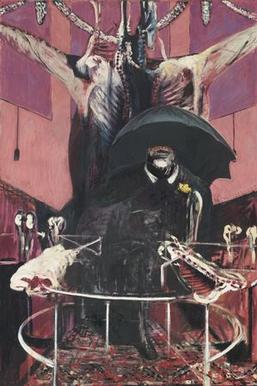
Painting by Francis Bacon, 1946, Museum of Modern Art

Painting

Francis Bacon • 1946 • Oil and pastel on linen • 197.8 × 132.1 cm • MoMA 211.1948

View at MoMA →
Teaching Focus: Color Creates an Emotional World

The surrounding plum, deep crimson, and muted magenta colors are not merely decorative background elements—they establish the oppressive, ceremonial atmosphere of an abattoir. A grimacing figure sitting under a black umbrella amidst suspended beef carcasses demonstrates how color and environment amplify the figure's sinister gravity.

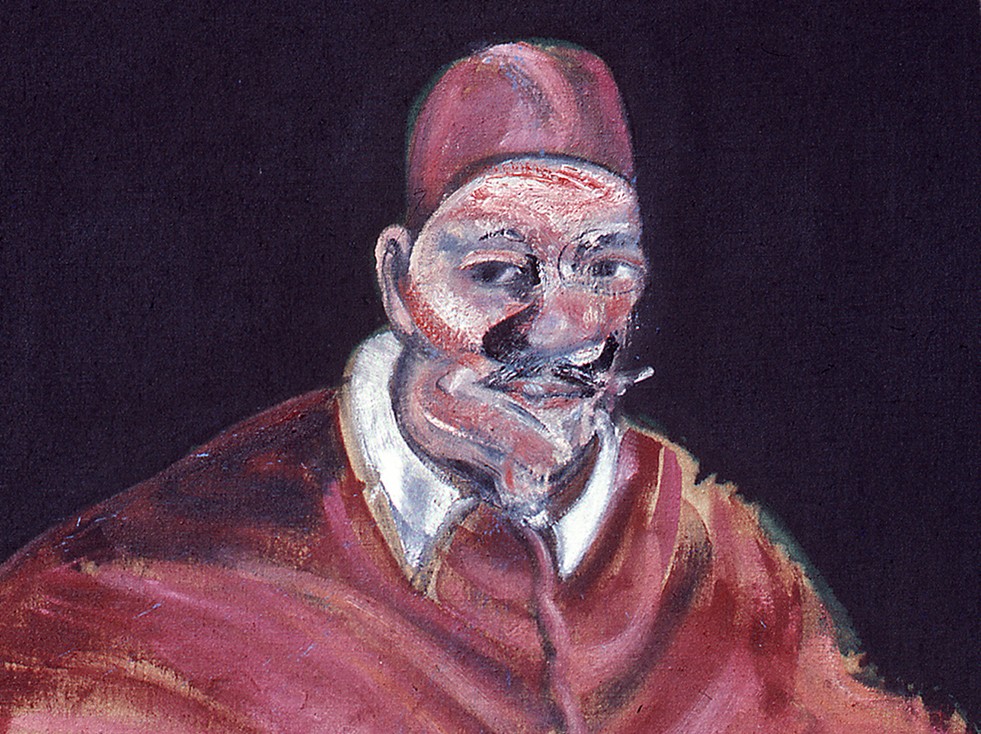
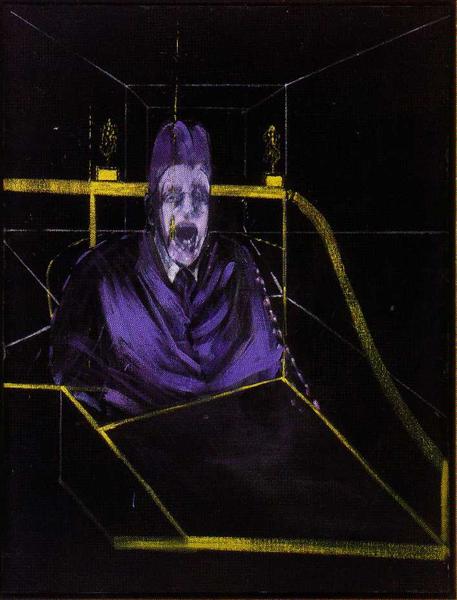
Study for Velázquez Pope II by Francis Bacon, 1961, Vatican Museums

Study for Velázquez Pope II

Francis Bacon • 1961 • Oil on canvas • 150 × 118 cm • Vatican Museums Collection

View at Vatican Museums →
Teaching Focus: Transformation + Isolation + Psychological Space

Bacon takes Diego Velázquez's historic 1650 portrait of Pope Innocent X and transforms an art-historical symbol of absolute spiritual power into a monument to existential vulnerability. Isolated on a stark throne against pitch-black void, the seated figure’s intense gaze and stripped surroundings turn majesty into solitary dread.

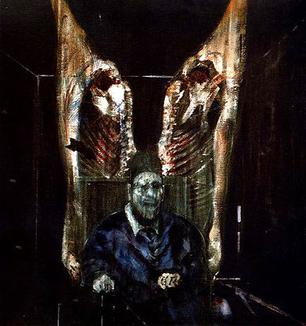
Figure with Meat by Francis Bacon, 1954, Art Institute of Chicago

Figure with Meat

Francis Bacon • 1954 • Oil on canvas • 129.9 × 121.9 cm • Art Institute of Chicago 1990.22

View at Bacon Estate →
Teaching Focus: Figure + Environment

The split carcass behind the enthroned figure echoes the outstretched wings of a dark angel or crucifix. Notice how the physical environment—the raw meat, the dark veil of vertical dry-brush strokes, and the skeletal gold chair—becomes an inseparable extension of the figure's psychological agony.

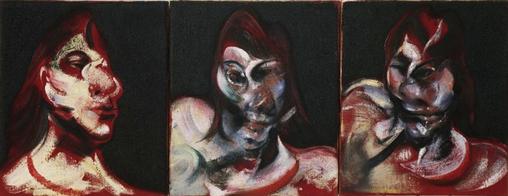
Three Studies for Portrait of Henrietta Moraes by Francis Bacon, 1963

Three Studies for Portrait of Henrietta Moraes

Francis Bacon • 1963 • Oil on canvas • 35.5 × 30.5 cm (each panel) • Private Collection

View at Bacon Estate →
Teaching Focus: One Person — Multiple Transformations

Bacon portrays the same close friend across three consecutive panels, applying different facial distortions, brush sweeps, and textural twists in each frame. This demonstrates that distortion is not a rigid formula but an exploratory search for emotional truth and psychological complexity across time.

Study for Portrait VII by Francis Bacon, 1953, Museum of Modern Art

Study for Portrait VII

Francis Bacon • 1953 • Oil on canvas • 152.3 × 117 cm • MoMA 254.1956

View at MoMA →
Teaching Focus: Facial Distortion + Sensation

A suited businessman sits formally in an armchair, but his mouth and lower face dissolve into a translucent scream blurred by vertical curtain-like brush strokes. Bacon pushes a conventional bourgeois portrait to the brink of emotional breakdown, showing that the recognizable face can be turned into a conduit of pure psychological tension.

3 Three Things to Notice

When observing Francis Bacon’s work, we can distill his approach into three foundational artistic principles:

🎭

1. Distort the Figure

Bacon altered recognizable human forms by stretching, compressing, obscuring, exaggerating, repeating, or dissolving features.

The Important Lesson: You do not have to distort everything. Leaving certain anatomical anchors recognizable makes the selective distortion far more shocking and emotionally potent.

📐

2. Create Emotional Space

Bacon’s surrounding spaces—geometric cages, orthogonal space-frames, curved railings, and vast flat planes—focus and intensify psychological tension.

Ask Yourself: “What kind of world would this emotion live in?” The space surrounding the figure should actively shape the feeling of the artwork.

🎨

3. Use Color for Feeling

Color does not have to describe reality or realistic flesh tones. Color can establish an overwhelming emotional atmosphere:

  • Blues: Sadness, distance, melancholy
  • Reds: Intensity, anger, passion, danger
  • Yellows: Energy, alertness, or uneasiness
  • Violets: Mystery, grief, dreamlike tension
  • Greens: Uneasiness, alienation, unreality

Note: These are not rigid rules. Every artist decides what color means in their own world.

4 The Alchemist Artist: Paint a Feeling

This is the most important creative exercise of the lesson. Instead of painting a person exactly as they appear in a photograph, choose ONE specific emotion or feeling and make that sensation visible through the human figure.

The Core Creative Question

“What sensation are you trying to make visible?”

The goal is not anatomical perfection. The goal is to make the viewer FEEL something. Use the three-step framework below to construct your original painting:

✦ 1. The Two-Distortion Rule

Choose EXACTLY TWO things about the human figure to distort. You may stretch, enlarge, shrink, move, exaggerate, repeat, obscure, dissolve, or transform them:

  • Unusually large or wide eyes
  • Exaggerated, open, or gaping mouth
  • Extremely elongated or tense fingers and hands
  • Elongated, strained neck or twisted spine
  • Disappearing, blurred, or smeared facial features
  • Sharply arched or heavy, expressive eyebrows
  • A facial contour melting directly into the background shadow

Important: The two distortions must directly reinforce the specific emotion you have chosen.

✦ 2. Color the Emotion

Ask yourself: “What colors belong in the emotional world of this painting?” You do not need to use realistic skin tones.

  • Select a dominant emotional color family (e.g., deep cobalt blues, burning crimsons, toxic chartreuse).
  • Choose 1–2 supporting tones that harmonize with the mood.
  • Add a deliberate contrasting accent color where you want the viewer's eye to lock in.

✦ 3. Build the World Around the Figure

Create an environment that supports your chosen feeling. Ask: “What kind of world would this feeling live in?”

  • An enclosed geometric cage or thin linear space-frame (for tension or trapped feeling)
  • A vast, silent empty void (for loneliness, grief, or contemplation)
  • A dense, turbulent, textured field (for anger, passion, or chaos)

5 Emotion Blueprints & The Grief Study

Review these example blueprints to understand how distortions, colors, and surrounding spaces work together to communicate specific human sensations:

Blueprint

Feeling: JOY

Distortions: Exaggerated wide smile + unusually open, radiant eyes.

Colors: Luminous yellows, warm oranges, vibrant coral pinks.

Space: Expansive, radiating composition with bright outward energy.

Blueprint

Feeling: ANGER

Distortions: Sharply angled furrowed eyebrows + enlarged, clenched fists.

Colors: Fiery crimsons, hot vermilion, deep contrasting black.

Space: Compressed, fractured room with sharp diagonal lines.

Blueprint

Feeling: FEAR

Distortions: Enormous dilated pupils + elongated or disappearing mouth.

Colors: Cold midnight blues, muted violets, sickly acid greens.

Space: Claustrophobic geometric cage pressing in on the figure.

Blueprint

Feeling: LOVE

Distortions: Exaggerated chest/heart volume + open hands reaching outward.

Colors: Soft rose pinks, deep warm madder, glowing amber.

Space: Enveloping, luminous atmosphere with soft blurred boundaries.

Blueprint

Feeling: LONELINESS

Distortions: Extremely frail elongated limbs + hunched compressed torso.

Colors: Desaturated ash gray, pale ice blue, muted dusty olive.

Space: Tiny figure marooned in a gigantic, monochromatic empty void.
6 Atelier Reflection & Sketchbook Inquiry

“You are not painting what the feeling looks like.
You are painting what the feeling feels like.”

When completing your figure painting, step back from your canvas or sketchbook and critique your work through these essential reflective questions:

  • Primary Sensation: What specific sensation or emotion were you trying to make visible to the viewer?
  • The Two Distortions: Which exact two anatomical features did you distort, and why did they reinforce the emotion?
  • Color Harmony: How did your chosen color palette and contrasting accents support the emotional temperature of the piece?
  • Spatial Tension: How did the environment, framing lines, or empty space surrounding your figure amplify the psychological feeling?
  • Recognizability: Did your figure remain recognizable as a human presence even after being expressively transformed?

7 Academic Sources & Museum Credits

The Alchemist Artists Master Artist Series uses authentic reproductions and verified collection records from the world's leading public cultural institutions. All links open directly to the specific artwork record:

Artwork Title Date & Medium Museum / Collection Accession / Object ID Direct Museum Record
Head I 1948 • Oil and tempera on hardboard The Metropolitan Museum of Art, New York 1999.363.1 The Met Collection Object 494826 →
Three Studies for Figures at the Base of a Crucifixion 1944 • Oil on board (triptych) Tate, London / Francis Bacon Estate N06171 Francis Bacon Estate Record →
Painting 1946 • Oil and pastel on linen The Museum of Modern Art, New York 211.1948 MoMA Conservation & Exhibition Record →
Study for Velázquez Pope II 1961 • Oil on canvas Vatican Museums (Collection of Contemporary Art) Sala 30 Vatican Museums Official Record →
Figure with Meat 1954 • Oil on canvas Art Institute of Chicago / Francis Bacon Estate 1990.22 Francis Bacon Estate Record →
Three Studies for Portrait of Henrietta Moraes 1963 • Oil on canvas (triptych) Francis Bacon Estate / Private Collection Cat. Raisonné 63-08 Francis Bacon Estate Record →
Study for Portrait VII 1953 • Oil on canvas The Museum of Modern Art, New York 254.1956 MoMA Collection Object 79285 →